Why do people fight over Gaza?
It’s a small sectarian turf war taking place in Western Asia after all. Why are they still fighting? The first reason is that the world declines to allow either side to lose. As long as you allow neither side to lose, the prospect of a victory for either the Palestinians or Israel means that the fighting will continue and more people will die. The continued fighting has produced more casualties than would have been the case if the war had been allowed to come to a natural conclusion. Those peaceniks and ‘progressives’ have a lot to answer for.
It is widely accepted by experts and international organisations that a speedier conclusion to the war in Gaza would have resulted in fewer overall casualties, especially given the current high rate of deaths from both direct violence and indirect causes. The prolonged nature of the conflict has exacerbated an already dire humanitarian situation, leading to a massive increase in deaths from a range of factors beyond direct military action.
Secondly, they fight because they want to because they want to. Both sides want peace, but a peace achieved through victory. Polling of Gazan and West Bank residents in October 2025 showed sufficient support to continue an armed conflict which is a good few decades old. Separate polling of Israelis showed even more support.
Human beings are territorial, exhibiting a range of behaviours from personal space to property ownership that are influenced by a mix of evolutionary instincts and social conditioning. This territoriality helps regulate social life, maintain privacy, and express identity, and can be observed in various contexts, from a personal “side” of the bed to large-scale political borders and warfare
How human territoriality manifests itself
Personal space: Individuals have a strong sense of personal space, which can be seen in how they position themselves in meetings or public transportation, and in their subconscious reactions to others who invade it.
Psychological ownership: Humans develop a sense of “ownership” over places like their homes, workspaces, or even a favourite chair, leading to behaviours that protect these spaces.
Social and political boundaries: Territoriality is a fundamental aspect of political geography, visible in the mapping of countries and the customs and laws surrounding property rights.
Non-verbal cues: Territorial behaviour is often demonstrated through unconscious body language, such as positioning oneself at a corner of a table to create a barrier or using a stare to assert dominance.
Influencing factors
Evolutionary instinct: The need to protect a territory for resources and safety is a primal instinct that persists in humans, similar to other animals.
Social and cultural norms: Societies have developed laws, customs, and beliefs that shape and acknowledge territorial behaviour, influencing how and why we are territorial.
Individual circumstances: The degree to which a person is territorial can change based on their circumstances and is not a fixed trait. Perception plays a large role, meaning that how we feel about a space or situation can trigger territorial responses.
Let us explore that which is primal and which we share with other species. Why do we take over territory? Land and all that contained therein consists of resources. The more resources you control, either as an individual or a group, the more water, fuel and food you have access to. This increases the survival chances both of those that control it, as well as their offspring. That is why people fight to take and hold land. The benefits outweigh the risk.

The prehistoric evidence is clear.
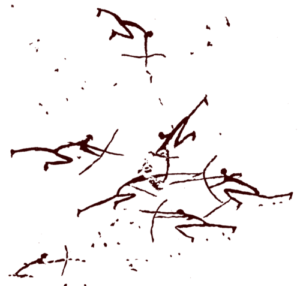
Some scientists argue that humans have a predisposition for violence. Chimpanzees, the great apes genetically 2nd closest to humans, are known to wage wars against other chimps over territories and resources. In Palaeolithic times we were less sedentary and population densities were low. Resources were plentiful. That seemed to have changed with population growth,a more sedentary lifestyle and a shortage of good land to expand into.
According to a Wikipedia article “ None of the many cave paintings of the Upper Palaeolithic depicts people attacking other people explicitly, but there are depictions of human beings pierced with arrows both of the Aurignacian-Périgordian (roughly 30,000 years old) and the early Magdalenian (c. 17,000 years old), possibly representing “spontaneous confrontations over game resources” in which hostile trespassers were killed; however, other interpretations, including capital punishment, human sacrifice, assassination or systemic warfare cannot be ruled out.
The most ancient archaeological record of what could have been a prehistoric massacre is at the site of Jebel Sahaba, committed against a population associated with the Qadan culture of far northern Sudan. The cemetery contains a large number of skeletons that are approximately 13,000 to 14,000 years old, with 24 out of 59 skeletons presenting arrowheads embedded in their skeletons, which indicates that they might have been the casualties of warfare.
The oldest rock art depicting acts of violence between hunter-gatherers in Northern Australia has been tentatively dated to 10,000 years ago. The earliest, limited evidence for war in Mesolithic Europe likewise dates to c. 10,000 years ago, and episodes of warfare appear to remain “localised and temporarily restricted” during the Late Mesolithic to Early Neolithic period in Europe. Iberian cave art of the Mesolithic shows explicit scenes of battle between groups of archers.
Systemic warfare appears to have been a direct consequence of a sedentary lifestyle as it developed in the wake of the Neolithic Revolution. An important example is the massacre of Talheim Death Pit (near Heilbronn, Germany), dated right on the cusp of the beginning European Neolithic, at 5500 BC. There researchers concluded that the absence of women among the local skeletons meant that they were regarded as somehow special, thus they were spared execution and captured instead. The capture of women may have indeed been the primary motive for the fierce conflict between the men.”
Conclusions
Well who’d have thought it? It turns out that capitalism wasn’t to blame after all. We naturally fight to take and hold land. As long as you allow neither side to lose, the prospect of a victory for either the Palestinians or Israel means that the fighting will continue and more people will die. Those Peaceniks and ‘Progressives’ have a lot to answer for.
Original references and academic papers used to produce this document have been saved as PDFs and appear below.