Wikipedia: “Christian nationalism is a form of religious nationalism that focuses on promoting the Christian views of its followers, in order to achieve prominence or dominance in political, cultural, and social life. In countries with a state church, Christian nationalists seek to preserve the status of a Christian state.”
It varies in form from country to country. Ireland had it throughout the 20th century, but is now becoming less Irish by the minute. Hungary and Poland have it to varying degrees. In both Britain and the USA it is linked to evangelism, and it has to be said that in the UK evangelism was on the rise anyway. Orthodox religions are a bit hard core and have grown in attraction to young males seeking a more disciplined lifestyle. In Britain Christian Nationalism is a response to the rise of political Islam and governmental attempts to give it more legal protection than other religions, eg through the introduction of a definition of Islamophobia, which clashed with equality laws
The BNP tried Christian Nationalism in 2006. It didn’t gain much traction then, but neither did the BNP. Nick Griffin and Tommy Robinson aren’t on the same song sheet these days. One of them went to Cambridge and got a history degree. The other’s working class and went to prison. His Unite The Kingdom rally drew in the religious right with sufficient popular acclaim to mount a successful Christmas carol service, much to the annoyance of London’s mayor and the British humanist community, who never tire of criticising Christianity, which they see as a threat to us all.
What we’re probably seeing here is cultural Christianity flexing its muscles, rather than a damascene shift. The Church of England used to be culturally Christian, but there seems to be a demand for some more robust Christianity to protect the culture. Culture, for those who haven’t thought much about it, is the glue which binds one generation to the next.
Established Churches
Mainstream churches seem uncomfortable about Christian Nationalism, forgetting that they only exist because of it. Nation-building processes in the Orthodox commonwealth brought together political institutions and religious communities in their shared aims of achieving national sovereignty. The churches of Greece, Romania, Bulgaria, and Serbia acquired independence from the Patriarchate of Constantinople in the wake of the Ottoman Empire’s decline, and formed their own denominations. Russia and Ukraine each have their own Orthodox branch of Christianity, tied to national identity. Within the Anglican church people seem to have forgotten why it got its name. You can’t really complain about Christian Nationalism when you are still called the Church of England.
The C of E in particular encapsulates all that socially conservative people think is wrong in society. There have been systemic safeguarding failures, deep internal theological divisions, and a perceived loss of cultural relevance. Gay marriage and blessings for same-sex couples are not exactly traditional Christian values, and Archbishop Welby declaring in 2020 that the Church remains “deeply institutionally racist” didn’t help either. Some critics argue the Church has become a “progressive NGO,” prioritising secular political causes (e.g., climate change, 19th century slavery, left-wing politics) over traditional evangelism and theology.
Critics of Christian Beliefs
Liberals and the Left are not particularly enamoured of Christianity. In 2017 LibDem MP Tim Farron announced his resignation as Liberal Democrat leader after he was repeatedly pressed during the general election over his personal beliefs on issues including homosexuality. Farron issued a statement saying he felt “remaining faithful to Christ” was incompatible with leading his party.
In Scotland. Kate Forbes, a prominent Scottish National Party (SNP) figure and former Finance Secretary, faced significant scrutiny during the 2023 SNP leadership contest due to her strong Christian faith, particularly her conservative views on issues like same-sex marriage and having children outside marriage, sparking debate on faith’s role in Scottish politics. So they elected a socially conservative Muslim instead, Humza Yousaf. He wasn’t asked any of those questions. Look how well that turned out.
Humanists are critical of attempts to reintroduce Christianity into politics. It’s not clear that they are as critical of religiously observant Muslim MPs doing the same form of identity politics.

Criticisms
Critics see Christian Nationalism as right wing, Fascistic and racist. In the USA around 30% of White people have some sympathy towards Christian Nationalism and around 34% of Black people feel the same way. It is normal in such cases to make the Critical Race Theory assumption that Black people can’t be racist, so it must be the Whites. The King is no fan of Christian Nationalism either – https://notwokedot.com/has-charlie-got-us-mullahed/
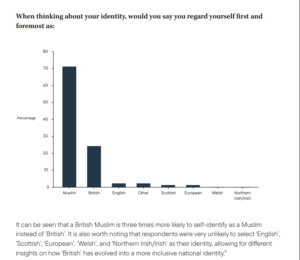
Is it Fascistic or right wing to ally your identity to a set of beliefs? Muslims do it. Islam is socially conservative and most British Muslims, as seen in the chart below, identify as Muslim over being British.