How weak is your sense of Identity?
Being labelled as English is something non-English ethnic minorities queue up to do. Other labels are not so durable as an identity that’s a thousand years old. Every ten years in the USA or UK we have had to invent a new word for black, as the previously invented term mysteriously becomes racist. People from East Pakistan who emigrated here became Bangladeshis, or even “South Asians”. Here is a vaguely chronological list.
Post War Minority Ethnicity Name |
Post War Name for the English |
| Negro – It means black in may languages, Became associated with slavery, colonialism,
and scientific racism. So it had to go. Coloured – Used to describe Black people, especially in the U.S. and South Africa. Eventually seen as patronising and vague. So it had to go. Darkie / Darky – Became a racial slur due to its use in minstrel shows, blackface, and demeaning stereotypes. So it had to go. 1920s–1960s: Negro (again) – By the 1960s, it began to fall out of favour due to civil rights and Black consciousness movements. So it had to go. Afro-American – Meant to affirm African heritage. Later replaced by “African American”. Coloured (again) – Phased out in the UK from official use in the 1980s and 1990s, r replaced by “Black” or “Black British”. 1990s–2000s – Black. Used as a political and cultural identity (e.g. “Black Power”, “Black British”). Then – African American / Black British. Then – Person of Colour / POC. Criticised for being too broad or erasing distinct Black experiences. So it had to go. BAME (UK: Black, Asian, and Minority Ethnic) Increasingly rejected by activists as overly vague, flattening differences, or bureaucratic. Global Majority is now in popular usage, or alternatively “Ethnically diverse”. Both simply mean anyone not White. It’s no more an identity than BAME was. Welsh, Irish, Scots and English are now the new ethnic minorities. |
ENGLISH |
Ethnic Slurs
If your ethnicity doesn’t have some really choice nicknames, then you’re really not important enough to deserve one. You’ve gone unnoticed. Better a bad name than no name at all
N*** (slur) Derived from “Negro” is universally recognised today as a racial slur, unless the speaker is black. Nigger is the word Negro spoken with a southern American English pronunciation. Negro is Spanish for black, from the Latin, Niger. There is no difference in meaning in the two words, in for example the Russian language:
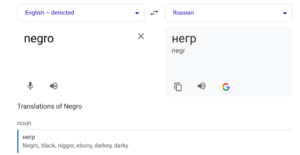
In one sense a proper racial slur has to carry a meaning additional to the actual name of the ethnicity, indicating a characteristic, a stereotype or characterisation.
For example:
Monkey- which is why we have seen football fans throwing bananas on the pitch when a black player comes on. It’s implying that the black player is inferior or sub-human.
Gammon and Little Englander are terms which carry stereotypical and negative meanings,
Coconut and Uncle Tom do likewise.
None of these are meant to be complimentary, but we’re allowed to say them, except ‘monkey’. Come to think of it, there are no derogatory terms for the English that people are not allowed to use. Pommy, Limey and even Honky attract little offence. This may be because older Brits were educated not to take offence at words, while the younger ones were taught to think of themselves in pejorative terms anyway. They have low self-esteem to match.
Paki by contrast was just shorthand for Pakistani, but is these days also considered a slur. Racists and non-racists used it alike right up until the 1980s. It certainly appeared in one episode of Only Fools and Horses, when Del sends Rodney down to the “Paki shop”. Bangladeshis used to be Pakis, but they had a war about that.
As soon as you can use a term offensively, it gets thrown out. The idea that banning the word Paki from every day speech has an effect on the disposition of White people or Indians towards Pakistanis is derived from the idea that it’s more difficult to fit a word of four syllables into a chant or meme, than it is to fit a two-syllabled word. The fact that these name changes occur so often for ethnic minorities is indicative that they’re not working, and provide no secure sense of identity. I mean, do people in India call themselves “South Asians”?
A Shaky and Contrived Sense of Identity?
There is deep insecurity there, because they are not real identities. The terms White, English or European are real and remain unchanged. So these must be strong identities.
In general, Africans living in Africa primarily identify themselves by their ethnicity, nationality, and culture, rather than using the term ‘black’ as a primary self-identifier in their daily lives. The concept of “black” as a racial category is largely a Western social construct developed in the context of colonialism and slavery. People typically identify first as a member of a specific ethnic group (e.g., Yoruba, Igbo, Maasai, Zulu) or by their nationality (e.g., Nigerian, Kenyan, South African, Eritrean). These identities are rooted in shared language, customs, and history.
In Pakistan national identity coexists with strong regional (Punjabi, Sindhi, Baloch, Pashtun) and ethnic affiliations, plus a broader Muslim identity. The average Indian person living in India primarily identifies as Indian by nationality and by their specific regional, linguistic, or caste identity. The term “South Asian” is a geopolitical or academic descriptor.
There are whole websites devoted to offensive racial slurs. Some of which you will never have heard of and some you won’t necessarily recognise as offensive. They are on the link below and demonstrate how ubiquitous the practice is. Many started life as mere slang words:
https://itg.nls.uk/wiki/Introduction
https://en.wikipedia.org/wiki/List_of_ethnic_slurs
https://en.wikipedia.org/wiki/Glossary_of_names_for_the_British
Conclusions
In the end, the merry-go-round of invented labels isn’t a sign of progress—it’s a symptom of fragility. Identities that need to be renamed every decade aren’t identities at all; they’re scaffolding propped up by academia, activism, and bureaucracy. If a word becomes offensive the moment it can be weaponised, that tells you the identity behind it has no historical spine to support it. Meanwhile, English, Welsh, Scots, and Irish sit there with thousand-year-old labels that don’t need updating, capitalising, or rebranding. The irony? The “majority” are the only people with no protected slurs, no fragile categories, and no semantic bubble-wrap. You’re only dangerous enough to police when your identity actually means something.
And this is the uncomfortable truth: the more feverishly we rename minority identities, the more we expose that the labels aren’t organic but manufactured—academic inventions trying to replace authentic cultural roots. African, Indian, Pakistani, Chinese, Russian—these identities have languages, histories, and civilisations behind them. “Global Majority” has a press release. No wonder people cling to real national, tribal, and cultural identities everywhere in the world except the West, where identity is now a bureaucratic mood board. If anything is suffering an identity crisis, it isn’t ethnic minorities—it’s a Britain that’s forgotten how to defend the simplest word of all: English.