National identity was once a quiet inheritance. You were born into a flag, a language, a set of traditions. Today, identity is no longer inherited — it is contested, curated, and weaponized. The wars of the 21st century are not fought with tanks and trenches but with passports, pronouns, and hashtags. Welcome to Identity Wars, where the fiercest battles are fought over who we are, and who gets to decide.
The Identity Wars are not optional. Whether you embrace tradition or fluidity, whether you cling to heritage or chase reinvention, you are already enlisted. The only choice left is whether to fight for a cohesive future or surrender to perpetual fragmentation. In this war, neutrality is impossible. The question is not if identity matters, but whose identity will survive the battle.
The Tribes
British Super Tribe – The United Kingdom of Great Britain & Northern Ireland is a source of pride to many people, who have subsumed their own national identity into it. British has also become a civic identity, encompassing immigrants who live in its constituent parts, but who are not indigenous to them. Without a Britain, they don’t have a country.
English – Naughty White people, with a small contingent of other ethnicities. The 2021 Census enumerated 17.3 million English people in an England of 57,690,000 people (2023 figure) and of a UK population of 68 million. This wasn’t perhaps the composition of the UK that they were born into and want to live with.
Welsh – An identity under threat from internal immigration.
Scots – People who don’t know whether they’re an ethnic group or not. A split from England is always on the menu, but one has managed to bring it to the table for a while. The population of Scotland is just 77% Scots, so independence seems increasingly unlikely. In the 2022 Census the percentage of people who said Scottish was their only national identity increased since the previous census (from 62.4% to 65.5%). The percentage who said their only national identity was British also increased (from 8.4% to 13.9%) and these may well be ethnic immigrant minorities. The percentage who said they felt Scottish and British decreased from 18.3% to 8.2%. Most Scots, it can be inferred, don’t think of themselves as British.
Indians, Sikhs, Chinese – Immigrant ethnicities, who apart from occasional clashes with Muslims, quietly just get on with things.
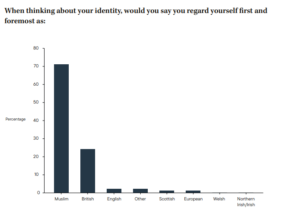
Muslims – In terms of numbers, now almost on a par with the Scots. There are four million of them, and in December 2024 polling “Mixed, Asian and Black Muslims showed a considerably higher likelihood of identifying as ‘Muslim’ over ‘British. When we look at younger Muslims, those under 50, the percentage ranges from 70% to 90%. Very few identified as English, Scottish or Welsh. Recent events such as the two Bangladeshi Tower Hamlets councillors who had been spending time in Bangladesh campaigning to become MPs there only serve to reinforce the validity of those survey results.
The anti-Patriots – More than half the population of England selected “British only” as their identity in the 2021 Census. This in part is because it was offered first as an option, rather than English, and they were white. Another reason is that Englishness identity is always downplayed, dismissed or ignored in England, so that many white English people have prioritised a British identity. Without a Britain, they too don’t have a country. The final reason is Anglophobia, a surrender to an EU identity, and a globalist position that thinks that borders are racist.
Black People – Britain’s Black population may not be partaking in any identity wars. Most came here from the Caribbean or directly from Africa, the latter forming the majority of the UK’s Black population. Most of them live in London or Birmingham. While Africans tend not to have a political voice, they are a majority.
That having been said, the Black British Voices study in 2023 found that just 12 percent were ‘definitely’ proud to be British, and that less than half (49 percent) felt British at all. A larger majority don’t see themselves as English either. Kenneth Awele Okafor, a former advisor on the JW3 Young Advisory Board for Jews of Colour, was born and raised in London with Nigerian heritage. He’s swallowed the rhetoric: “I always felt proud that we helped them to build up this economy. If it wasn’t for us this country would be nothing”.
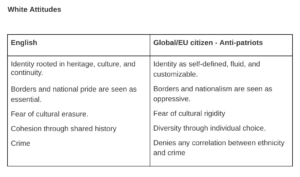
Tabulated Assessment
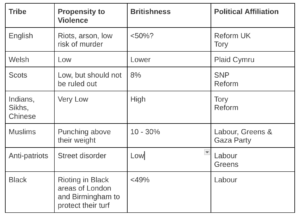
The political establishment is pro-Union, and reliant upon the UK for its existence, Labour, Conservatives certainly, but less so for LibDems and not at all for the nationalists, or the Green Party. Reform UK has Britishness written into its name as well, and no prime minister wants to go down in history as the one who broke up the UK.
Labour and the Greens want the Muslim vote and have come to rely upon it, and some Muslims have fallen out with Labour for being too British. Activists in the 2024 election told Starmer that having the Union Jack on their election pamphlets was “problematic”.
Choosing the Battlefield
The Identity Wars are not optional. Whether you embrace tradition or fluidity, whether you cling to heritage or chase reinvention, you are already enlisted. The only choice left is whether to fight for a cohesive future or surrender to perpetual fragmentation. In this war, neutrality is impossible. The question is not if identity matters, but whose identity will survive the battle.


