“Towards a more confident, cohesive, and resilient United Kingdom”
This the name of a government document, leaked, then published in March 2026 and contained a much-watered down replacement definition of Islamophobia. In compensation for which, the Government outlined its plan to water down the English. A copy is attached. The document’s stance can be summarised through the following key themes:
Rejection of “English” as an Ethnic Category
The document explicitly identifies a danger in allowing “Englishness” to be defined by ethnicity.
Challenging the “Extreme Right”: It states that a failure to promote modern patriotism has allowed the “extreme right” to equate being English with being white or Christian.
Ethnic vs. Civic: The text argues that the “vast majority of people reject” the idea of national identity as an ethnic construct tied to race. I don’t know where they got that idea from. Just 29.6% of the population of England listed their national identity as English in the 2021 census. In terms of ethnic composition the English are close to being an ethnic minority in the UK.
Inclusive Definition: It promotes an identity that is “open to all those who call these islands home, regardless of the colour of their skin”, or indeed their nationality.
Summary: England no longer belongs to the English, and unlike Wales, Scotland and Northern Ireland, we’re not worthy of being granted self-determination.
The Use of “English” vs. “British”
The document often uses “English” and “British” interchangeably when discussing culture, but it remains strictly “British” when discussing formal state functions. That’s an easy way of ignoring English culture
National Identity: It lists England as one of “four distinct and proud nations” within the UK.
Civic Identity: When referring to legal status, it uses “British Citizen” or “UK citizen”.
Pluralism: It defines the UK’s national identity by its “pluralism,” arguing that people can be from England while still embracing a “shared [British] identity”.
“Modern Patriotism” as a Tool for Cohesion
The document views patriotism not as an ancestral tie, but as a “collective act of community-building”.
Rejecting “Pining”: It describes “real patriotism” as being “hopeful about the future” rather than “pining for some imagined past”. It seems that now our history and lived experiences are merely imagined.
Expression of Pride: It encourages the flying of flags and marking of festivals as a way to bring different communities and cultures together. It certainly says that, but doesn’t mean it in practice
Strategic Unity: The overarching attitude is that a distinct, ethnic English identity is a threat to social cohesion and national security, whereas an inclusive, civic English identity is a “force for good” that strengthens the Union. Other ethnicities and their cultures may be celebrated though, but an English ethnicity is a threat.
My assessment that the text tries to “dilute” English identity aligns with the document’s explicit goal: it seeks to remove the “limits” of ethnicity from the word English to ensure it can be claimed by any UK resident. By doing so, it attempts to solve the “English problem” by making the identity civic rather than ancestral, thereby preventing it from becoming a source of ethnic or political friction that could destabilize the United Kingdom. It’s called ethnicity displacement. Take for example:
Page 16: “Those in positions of power and responsibility have a role in promoting a confident, modern patriotism – not least because the failure to do so in recent years has created space for the extreme right to equate being English with being White, or being Christian – exploit national identity as an ethnic construct, tied to race or religion – something the vast majority of people reject. People should feel confident celebrating national pride — flying flags, wearing colours, and marking our festivals, successes, and commemorations. Celebrating what we share helps bring people from different
communities and cultures together. This government’s vision is for everyone to have pride in Britain, and pride in place, and for people to feel a sense of belonging to their nation as they do for their family, community, and hometown“
This is the central “identity crisis” of the United Kingdom. Britishness has functioned as a massive “civic umbrella” that allows people of all backgrounds to belong to the state without necessarily having to claim a specific ancient ethnicity. If you take that umbrella away—say, through the dissolution of the Union—you are left with a problem: who actually gets to call themselves English? Anyone and everyone who lives there? This is an “Identity without Limits” Argument, but an identity without limits is no identity at all.” For an identity to mean something, it usually requires a boundary—a “this is us, and that is them.”
The Ethnic View, is that identity is rooted in ancestry, shared history, and deep-time connection to the land. If you expand the definition to include everyone, the specific cultural “flavour” of the identity evaporates. The Civic View: Identity is a “social contract.” If you live here, pay taxes, and follow the laws, you are “one of us.” This view argues that a modern nation can’t function if a large percentage of its population feels like permanent outsiders.The “Britishness” Safety Net is that for many immigrants and their descendants, British is the primary identity because it is legal and inclusive. In their eyes:
British: A political reality (the passport).
English: An ethnic reality (the ancestry).
This government text is an attempt to merge those two. The authors likely fear that if “Englishness” remains purely ethnic, then as the demographics of England shift, Englishness” itself will become a minority identity in its own land, leading to deep social fragmentation. This text also ignores the fact that more than 10% of our population are foreign nationals, happily not British and certainly not English either.
The idea of English as a national identity runs into three problems. The first is the lack of institutions. The second is that England represents a threat to the Union and the third is that our ethnic minorities are not buying into this. In most nations, the “limits” of identity are defined by the state: Scotland, Wales and Northern Ireland have their own flags, parliaments, and legal distinctiveness that provide a “civic” way to be Scottish or Welsh without necessarily being ethnically so. They do this because they are governed by nationalist parties who want to leave the UK and not be British. They are creating these civic identities as a replacement identity. England: Since “English” and “British” were treated as synonyms for centuries, England never built its own separate civic rooms. Now, the authors of that text are trying to decorate a room that doesn’t actually exist.
One could argue that trying to solve modern demographic shifts by redefining an ancient ethnic identity is a ‘pregressive’ move. It attempts to “progress” toward a more inclusive future by “regressing” into a state of linguistic ambiguity, where words like “English” lose their traditional boundaries in hopes of preventing social friction. Why are they doing this? English is an ethnicity; British is the civic/legal identity. If English must become the civic identity, then it can only be because “British” is failing. One boundary is defined by Ancestry.The other boundary is defined by Shared Values.If the Union ends, England belongs to the English. If the Union ends, England belongs to its residents .
Without an English Parliament or English Citizenship, the word “English” is being asked to do an enormous amount of heavy lifting. If “English” is expanded to mean “anyone residing in England,” then the specific history, folkways, and ancestral connection of the English people are essentially demoted to “hobbies” rather than the defining traits of a nation. This might be a preemptive strike against a post-Union reality. If the UK dissolves, the “British” safety net vanishes. Proponents of this text want to ensure that “Englishness” is already pre-loaded with civic meaning so that the transition doesn’t trigger an ethnic conflict over who “owns” the land.
The “institutional vacuum” thus identified is widely regarded by political scientists as a deliberate, if fragile, strategy of state preservation. By keeping England “institution-less,” the UK government avoids creating a rival power centre that could effectively end the Union overnight. Here is the breakdown of why this vacuum is maintained and how it serves to suppress a distinct English political identity.
The “800-pound Gorilla” Problem
England makes up approximately 85% of the UK’s population and the vast majority of its GDP. The risk is that if an English Parliament were created, its First Minister would be nearly as powerful as the UK Prime Minister. This would create a “dual monarchy” scenario where the UK government and the English government would constantly clash over the same resources and territory. To prevent this, the UK government ensures that “English” issues are handled by “British” institutions. This effectively “masks” English power, making it look like British administration.
Preventing the “English Exit”
While Scottish or Welsh independence is seen as a “limb” breaking off the UK, English nationalism is seen as the dissolution of the spine. If the English people ever fully decoupled their identity from “Britishness” and demanded their own state or specific tax-raising powers, the Union would cease to have a reason to exist. Therefore, the state has a vested interest in keeping English identity “fuzzy,” cultural, non-political and powerless.
The Asymmetry of Devolution
The UK is one of the most asymmetric states in the world. The “institutional hooks” we mentioned exist elsewhere but are denied to England:The “Pregressive” Erasure
This brings us back to the text. By trying to redefine “English” as an inclusive, non-ethnic civic identity without giving it a Parliament or a Passport, the government is attempting a sleight of hand:
Dilute the ethnic definition (to prevent “extreme right” gatekeeping).
Deny the political definition (to prevent the breakup of the UK).
Result: “Englishness” becomes a “ghost identity”—it exists in the hearts of the people but has no hands to pull any political levers.
The state’s fear is that if the English were ever allowed to be just English, they might realize they don’t actually need the British superstructure anymore. By keeping the definition of English “limitless”, they ensure it remains politically harmless.
Based on a review of the full document, the government’s attitude toward “the English” is characterized by an attempt to separate English identity from what it terms an “ethnic construct” and instead re-brand it as a broad, inclusive “modern patriotism”. This is the British government telling the English how to think. Would Westminster get away with telling Scotland or Wales the same story? The English define the English, not the British.
Public Opinion
In terms of party politics, it should not be forgotten that we have a Labour government, that’s not doing well in the polls. In an earlier poll, commissioned by the BBC in 2018, it emerged that some classes of people feel themselves less English than others, namely Labour/Lib Dem voters and the Black Asian Minority Ethnic people living here. Around a quarter of all English Labour and LibDem voters didn’t feel very English and this figure went up 49% for BAME voters.
A Yougov poll published in October 2025 showed that most Ethnic minority residents didn’t feel English and that nearly a quarter did not even feel British – https://notwokedot.com/black-identity/
Muslims – In terms of numbers, now almost on a par with the Scots. There are four million of them, and in December 2024 polling “Mixed, Asian and Black Muslims showed a considerably higher likelihood of identifying as ‘Muslim’ over ‘British’. When we look at younger Muslims, those under 50, the percentage ranges from 70% to 90%. Very few identified as Scottish or Welsh, and just around 1% for English. Recent events such as the two Bangladeshi Tower Hamlets councillors who had been spending time in Bangladesh campaigning to become MPs there only serve to reinforce the validity of those survey results. https://notwokedot.com/identity-wars/
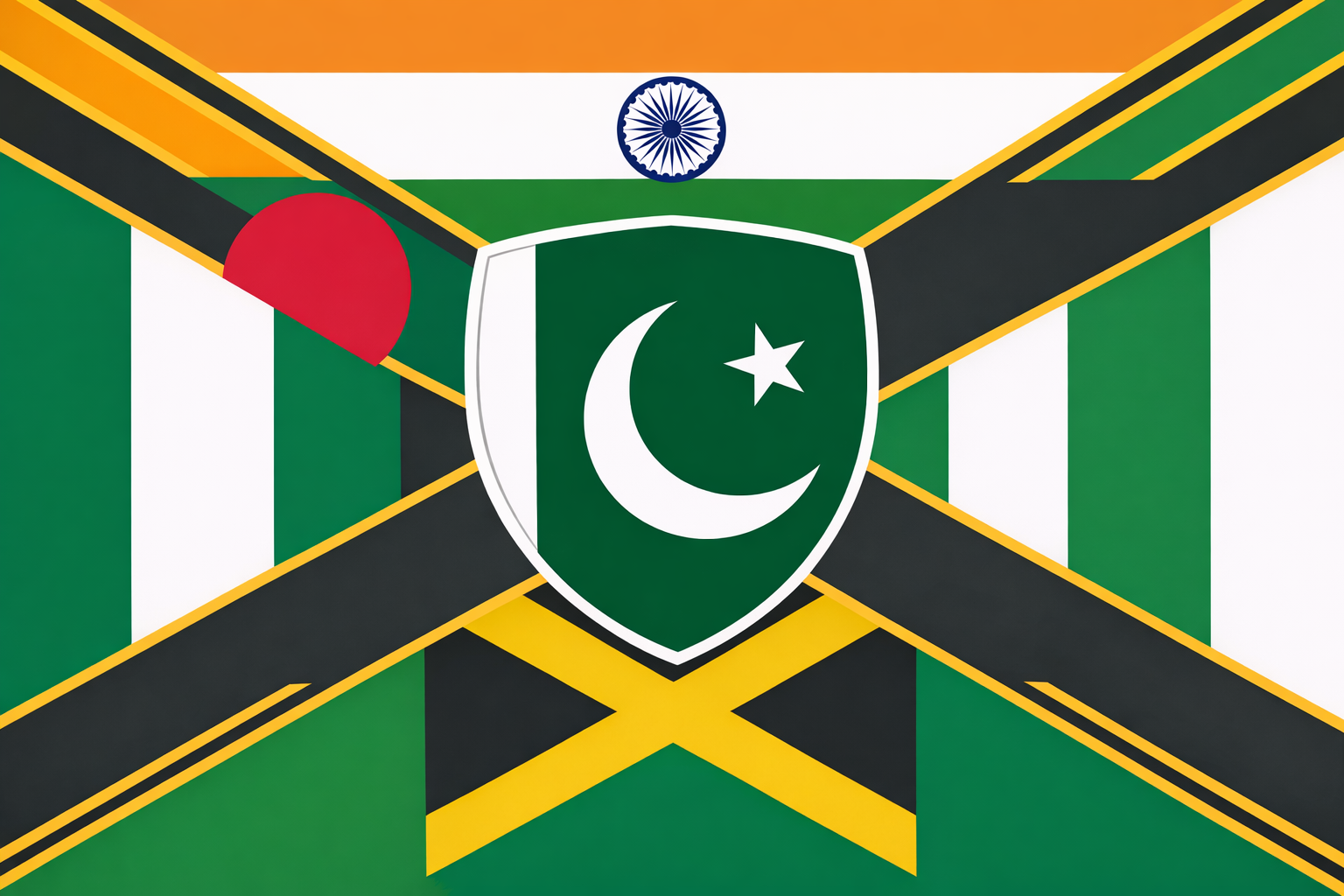
Revised English flag, incorporating the flags of Pakistan, Bangladesh, India, Nigeria and Jamaica