This is a Guest Post. The manifesto itself is appended to the bottom of this page to read or to download.
About:
The Anglecynne Manifesto is a political and philosophical text arguing for the creation of a distinct English nationalist movement, which it calls Anglecynne. The author contends that England lacks a coherent national identity and political representation, unlike Scotland and Wales, and claims this absence threatens England’s survival and stability.
The manifesto is built around a rejection of what it calls revolutionary ideologies, especially Liberalism and Economism. These are described as destructive belief systems that deny biological reality and natural limits. Liberalism is portrayed as corrosive to human personality and social order, while Economism is described as the worship of money and economic growth at the expense of ecological and biological survival. Together, they are framed as a rejection of life itself, rather than merely political or economic errors.
A central theme is opposition to revolution as a method of change. The author contrasts revolution depicted as violent, ideological, and driven by hatred of the past with reform, which is portrayed as gradual, evolutionary, and aligned with natural selection. The manifesto repeatedly invokes biology and evolutionary principles, arguing that human societies must conform to natural constraints, particularly the conservation of what has evolved and only marginal change over time.
The text asserts that humanity is a social species whose fundamental unit of survival is the nation. Nations are defined not as political states but as biologically and culturally evolved groups adapted to specific environments (earth, race and way). From this perspective, borders, exclusivity, and national closedness are described as necessary for survival, analogous to biological immune systems. Open borders, multiculturalism, and mass immigration are presented as violations of this natural order.
Anti-racism is treated as a core component of Liberalism and is described as unnatural and destructive. The manifesto argues that anti-racism leads to the erosion of national identity, the denial of biological differences between populations, and ultimately hostility toward the native population. It frames anti-racism as evolving into a coercive ideology that suppresses dissent, rewrites history, and criminalizes expressions of national loyalty.
The author links contemporary social issues such as permissiveness, consumerism, welfare dependency, and what is termed the Cult of the Forever Child to the breakdown of responsibility, adulthood, and intergenerational continuity. These developments are described as producing psychological fragility, social disorder, and environmental destruction.
Historically, the manifesto attributes modern English identity problems to the legacy of empire. It argues that Britain failed to relinquish imperial pride after decolonization and instead transformed it into a patronising moral ideology expressed through anti-racism. This, the author claims, resulted in mass immigration and the erosion of English nationhood.
The manifesto concludes by presenting Anglecynne as a corrective force intended to end the Age of Revolution, restore biological and ecological limits, reassert national belonging, and reconnect humanity to the Earth. It frames this project as an act of love rooted in duty, survival, and acceptance of natural constraints, contrasting it with what it portrays as nihilism and self-destruction.
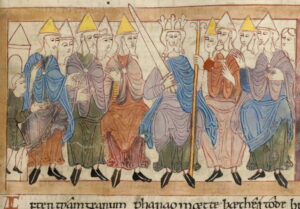
Early English Witangemot, a meeting of the Witan: