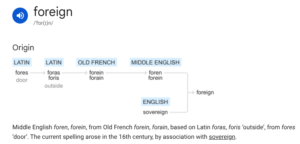
IT MEANS THE SAME AS OUTSIDER.
Your world is divided into ‘in-groups’ and out-groups’, the groups of people with who you share something and the out-groups with whom you share nothing. The German word for foreigner is Auslander, someone outside the land, and the French is étranger, from which we get the word ‘stranger’ and ‘strange’. There is a sort of Anglo-Saxon word for foreigner, which is still in use to today, and seen in various forms all across Europe. It’s the word ‘Welsh’:
Wealas: The Old English term used by the Anglo-Saxons to refer to the native Britons as “foreigners” or “strangers”. They’re the out-group.
It is also where the word Cornwall comes from. In Belgium there are two main ethnic groups, the Flemish-speaking Flemish and the French speaking ‘Walloons’, so named after their Gaulish ancestors. All foreigners are in the same out-group.
The border region between the Czech Republic and Poland is known as the Tatra (Giant) Mountains. In the 14th and 15th centuries foreigners who spoke a non-German language came to the mountains. They were called “Wallen” (see Walha),
Walhaz is a reconstructed Proto-Germanic word meaning ‘foreigner’, or more specifically ‘Roman’, ‘Romance-speaker’ or ‘(romanized) Celt’. The term was used by the ancient Germanic peoples to describe inhabitants of the former Roman Empire, who were largely romanised and spoke Latin languages. Other examples include Valland in Old Norse and Valskr, the Old High German Walhisc, New High German Walsch, used in Switzerland and South Tyrol (Walisch) Dutch Waals, ‘Walloon’; Old English welisċ, wælisċ, wilisċ, meaning ‘Brythonic’. The forms of these words imply that they are descended from a Proto-Germanic form Walhiska.
CONCLUSION
What you should take from this is that right across Europe, the Germanic peoples didn’t care who other people were as such, just that they were foreign and spoke a different language. It was an important distinction, whose shadow we still live under today, 1,000 – 2,000 years later.
The existence of a mechanism like Walhiska- across diverse cultures and geographic regions demonstrates that the process of “Othering” is a near-universal human tendency. It is a fundamental aspect of social identity formation. All groups define a “we” in opposition to a “they,” creating in-groups and out-groups. This process is not confined to one era or one society, but is an enduring feature of human social dynamics.
RELIGION
Generally speaking foreigners had their own gods and they believed in them. So ethnicity and religion were intertwined as part of the culture. Then along came the newer Abrahamic religions and some prosyletising. They brought with them a new word for religious otherness, the non-believer. Muslims call them Kafir, while the Jews call them Kofer and more latterly, Goy. Christianity was stuck. Late into the game, they discover that all the unbelievers already had a name, and that to some people, Christians were already unbelievers. As Christianity spread, it did so in a manner other than how it had first evolved. It spread from city to city, urbanus ad urbanus, as it were. Just the people out in the countryside retained their old religions. Accordingly, new Latin and English words for atheist developed:
Think French ‘Pays’ meaning countryside and you can see the Latin form, pagan. This is why English people think of Vin du Pays as ‘foreign piss’. (The north Germanic people drank mead.) The German and English languages came up with the same idea as Christianity spread. Heathen means heath dweller, and the German equivalent Heider meant someone living on the Heide (heath). From an Anglo-Saxon Christian perspective, what you didn’t believe was more important than what you did believe, in the same way that foreign defined what you were not, rather than what you were. In conclusion, we don’t like people who are not us.
LANGUAGE
Language is perhaps the most powerful and immediate marker of identity and difference. The inability to speak the in-group’s language serves as an immediate identifier of foreignness. The use of a single, generalised term for all non-speakers of one’s language highlights how linguistic difference is often reduced to a simplistic binary, ignoring the complex realities and internal diversities of the “Other” group.
Anthropologically, the formation of an “Other” can be linked to a basic, perhaps evolutionary, tendency towards ethnocentrism and a fear of the unknown or the unfamiliar. Strangers represent potential threats to a group’s resources, safety, or cultural norms. By lumping foreigners into a single category and labelling them with a single term, the in-group simplifies its world, manages perceived threats, and reinforces its own internal solidarity and sense of belonging.
SUMMING UP
The widespread application of the Walhiska- root is a powerful historical example of how “otherness” is socially and linguistically constructed to manage interactions with the external world and solidify a unified sense of “Self” within a group. This process, rooted in fundamental human social psychology, is a ubiquitous phenomenon observed across all cultures and throughout history.
This natural fear of strangers has deep roots. Humans often dislike those who are “different” due to an evolutionary fear of the unknown, which leads to out-group bias, and is reinforced by psychological factors like the desire to maintain a sense of security. This tendency was once a survival mechanism.
MODERN EXAMPLES
Thus when a bloke called Mouthin Ali celebrated his election victory in Bradford, in a foreign language, by shouting “Allahu akbar” he was demonstrating his otherness to the English who didn’t vote for him. If that weren’t enough, that’s not a chavvy Burberry scarf that he’s wearing either. He is in fact othering us, not the other way around.
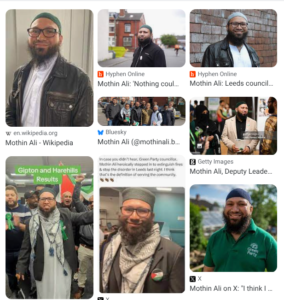
Let’s not blame him for this. Islam is very good at ‘othering’. It bans its women from marrying others and thinks that in a perfect world ‘Others’ should not exist. These rules were of course for ‘others’ living among them. It enslaved ‘others’, but not Muslims. England too had special rules for the Welsh living among them, and since at the time of the Domesday Book about 10% of England’s population had slave status, it’s quite fair to say that we didn’t practise that form of religious discrimination.
Ali, who represents Gipton and Harehills on Leeds City Council, shared details of the encounter on X (formerly Twitter) in a full public statement. Dressed in traditional ‘Muslim’ clothing (thobe and prayer cap) while on his way to London to speak at the EuroAsia Curry Awards in October 2025, he was confronted by a man who called him a Paki and threatened him with violence.
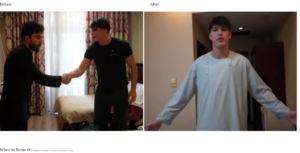
Recently an English You Tuber travelled to Afghanistan on a tourist visa. As soon as he met up with his tour guide in the hotel, his tour guide gave him some traditional Afghan clothes to wear for the duration of his stay, telling him that he would stick out less, fit in more, and so be better accepted by locals. The tour guide understood otherness and how it makes some people act. For Ali it’s a chosen lifestyle.
https://www.youtube.com/watch?v=U61I1Wycbi8