In the 2021 England and Wales Census more than half of the usual resident population (54.8%, 32.7 million) chose a “British” only national identity.. Those identifying as English, Welsh or Scottish numbered somewhat less:
Welsh – 1,957,725
English – 17,307,000
Scots – 4,300,000
The total population of Great Britain at that time was 59.7 million.
The message is though, that you have to assert your national identity , or pretty soon you won’t have one. You’ll have someone else’s
Perspective
Scotland with its low numbers of people born outside the UK is doing well in terms of national identity, Wales and England less so. Wales is just 63.3% Welsh and English identity was fading with the Conservative government and its policy of mass immigration. Perversely, English identity may have been rising since the 2024 General Election. Perversely, because Labour and the LibDems did rather well in the last election, but they are the two political demographics least likely to identify as English.
In a poll conducted in 2018, commissioned by the BBC, it emerged that some classes of people feel themselves less English than others, namely Labour/Lib Dem voters and the Black Asian Minority Ethnic people living here. Around a quarter of all English Labour voters didn’t feel very English and this figure went up to 49% for BAME. London was twice as un-English as any other part of England.

In the 2021 Census people were asked firstly whether they identified as British, with English being the secondary question. This may have skewed the results somewhat, because that was the opposite to the way the question was phrased in 2011. It wasn’t in the 2001 Census at all.
Terminology
National identity is a feeling of attachment to a nation. This does not need to be the same as ethnic group or legal nationality (citizenship). For example, this could be about the country or countries where a person feels they belong or they think of as home.
Ethnicity describes a group of people, where group members have a shared ancestry, homeland and a common history, The group itself has some or all of the following characteristics; sometimes a distinct appearance, a common language, a distinct diet, often a religion, or a style of dress, and which has its own culture, laws and customs.
Scotland
On Census Day, 20 March 2022, the population of Scotland was estimated to be 5,436,600. This is the largest population ever recorded by Scotland’s Census. In 2022 over half a million people living in Scotland were born in the rest of the UK (563,500). A further half a million were born outside of the UK (554,900).
Scotland’s Census asked people to choose the option that best described their ethnic group or background. The majority of people in Scotland chose ‘Scottish’ (77.7%) or ‘Other British’ (9.4%) within the White category. In 2022 these groups together made up 87.1% of the population. Atheists are 51.2% of Scotland’s population and Muslims just 2.2%.
5,436,500 minus those born outside Scotland (1,118,400) means there are around 4.3 million Scots.
Muslims
Muslims, 2.2% of the population, number 108,750 people in Scotland and 4.0 million in England and Wales, so about 4.1 million in total for the UK. By the time of the next census, Scotland will be losing its significance, since there will be more Muslims in the UK than Scots. Increasingly Muslims think of themselves “first and foremost” as Muslims and not part of a national group or ethnicity. (See https://notwokedot.com/british-muslim-attitude-surveys). It is for this reason they are included here.
England
In England people were asked if they thought of themselves as English only, or British and English. An ONS publication released in November 2022, called “Statistical bulletin -National identity, England and Wales: Census 2021”. It says of English identity in England, that:
“15.3% of people selected an “English” only identity
14.3% of people selected both “English” and “British” identity”
That’s less than 30% of the population of England. You’re now a minority if you’re English. The Population of England was said to be around 57,690,000 in 2023. 30% of that is 17,307,000.
Wales
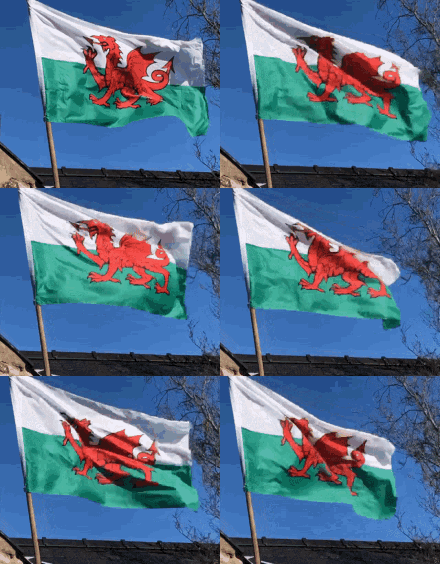
In Wales, The number of people choosing “British” only as their national identity rose in Wales from 16.9% (519,000) in 2011 to 18.5% (574,000) in 2021. This coincided with a decrease in those choosing “Welsh” only to describe their national identity (55.2%, or 1.7 million, which is down from 57.5%, or 1.8 million, in 2011). 8.1% of people selected both “Welsh” and “British” identities. So that means that Wales is just 63.3% Welsh. The population of Wales in 2021 was 3,107,500. 63.3% of that is 1,957,725.


