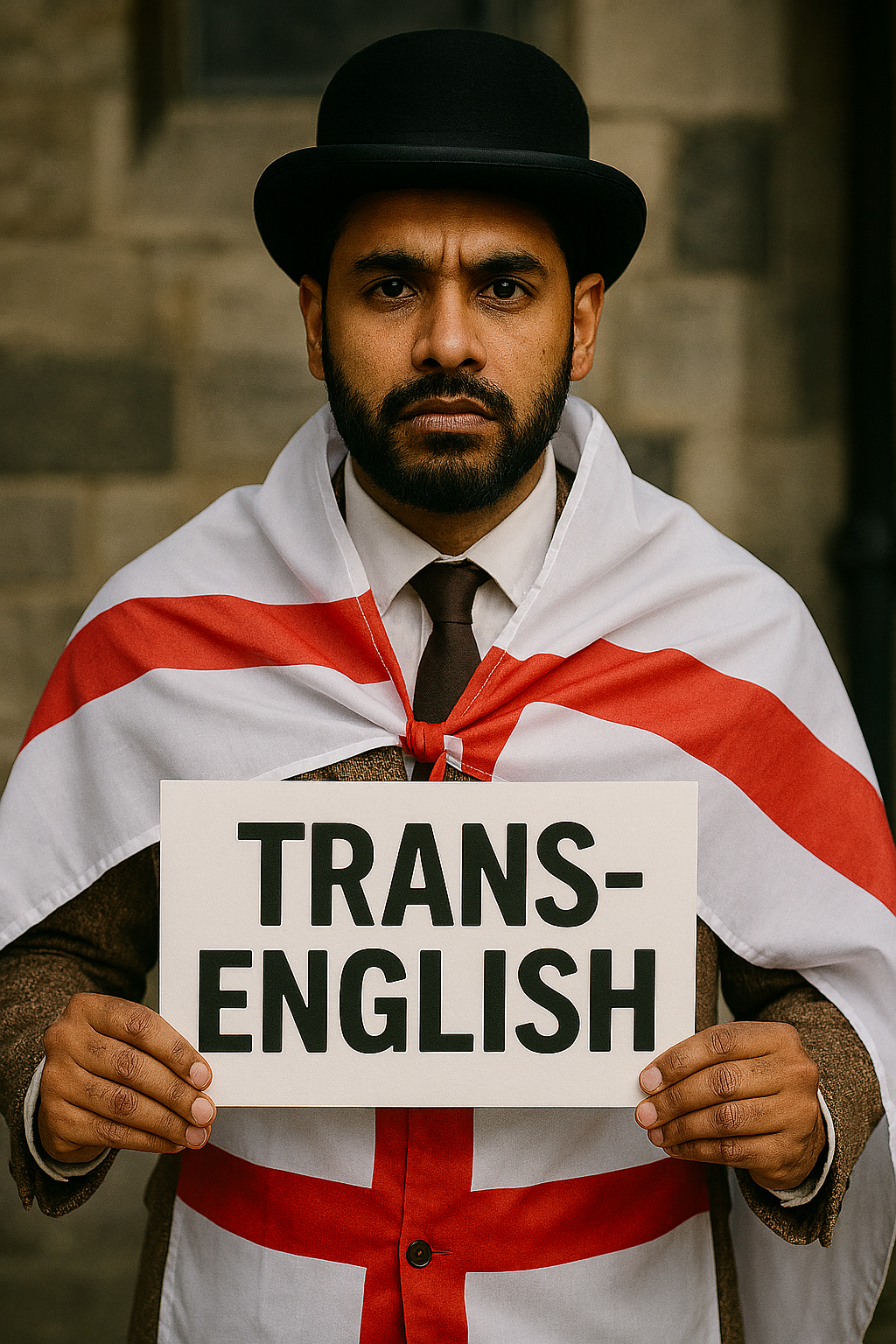
Has the English identity been subtly marginalized in modern Britain? With shifting demographics and policies, understanding the true essence and representation of being English has become increasingly complex. Let’s delve into the factors influencing English identity today.
Introduction
If you are English, you’ve been airbrushed. It’s a polite form of erasure.

Mass immigration happened and British citizenship was granted to millions of people who were not Scots, Welsh, Irish or English. Where do most of these new non-native British British citizens live? Why in England of course. These new British citizens needed to feel at home, and might feel uncomfortable living in someone else’s homeland (England), so society played down the idea that the English were a people and played up the idea that England was a place, a place in fact for anyone.
Many people, who are pro-immigration, would deny the existence of the English as a people, and promote the idea that anyone can become English, by living in England or being born in England. The English are in fact an ethnic group and you don’t acquire your ethnicity through any geographic process. English is an ethnicity and the English are an ethnic group. Other ethnicities in Britain recorded by the ONS include Black, Asian, Pakistani, Jewish. Indian, Bangladeshis, Scottish and Irish. From whom do the Jews, Blacks, Asians, Pakistanis, Indians and Bangladeshis in Britain get their ethnicity? The answer is their ancestry. You can’t change your ancestry and you can’t change your ethnicity.
What is an ethnic group?
An ethnic group is one which group members have or share most, if not all, of the following; a common language, a shared ancestry and a homeland, its own literature, sometimes a distinct appearance, a shared history, a distinct diet, often a religion, or a style of dress, and which has its own culture, literature, laws and customs. Let’s look at those then.
The English

Language – that’s easy, it’s English with an English accent
Ancestry -We are of mixed Celtic and Germanic stock. The Celts were from the island of Britain and our Germanic ancestors came from a small contiguous area straddling Denmark (Angles and Jutes), northwest Germany (Saxons and Frisians) and the northern part of the Netherlands.
History – English history is distinct from Scottish and Pakistani history. It’s not African or Caribbean history either. Drake, Alfred the Great, Agincourt, Crecy and the Battle of Hastings are part of our English history. British history starts in 1707 when Great Britain was formed.
Homeland – our homeland is England, a country created from the integration of our Germanic/Celtic ancestors and the mergers of seven Anglo Saxon kingdoms. England as a kingdom was created as such by King Athelstan, grandson of Alfred the Great, in the 10th century.
Diet – roast dinners, fish and chips, dunking biscuits, soft boiled and scrambled eggs, tea drinking, Full English Breakfasts, beer, cider etc.Religion – Christian, even if only culturally so, and mostly Protestant,Dress – There is little these days particularly English about out clothes, or so we think. Once we go abroad though, we’re soon spotted. Barbour jackets and green wellies, Burberry and bowler hats are at least more English than the American styles we slavishly copy. Badly dressed might more accurately describe us.
Physical Appearance – Yes, you look like virtually every other European. You don’t though look Mongolian or like a Pygmy.
Literature – Chaucer, King James Version of the Bible, Shakespeare, Dickens, all those weird poets, Agatha Christie etc.
Laws – English Common Law, still running after a thousand years, Parliament
Culture – Music, monarchy, country pursuits, pubs, sport (football, rugby and cricket), stately homes and the countryside, apologising, queuing and so on.
Note:
There is of course a legal definition, to which the above is closely defined. The House of Lords gave a ruling on this back in the 1980s on a test case and held the following.
“For a group to constitute an ethnic group in the sense of the 1976 Act, it must, in my opinion, regard itself, and be regarded by others, as a distinct community by virtue of certain characteristics. Some of these characteristics are essential; others are not essential but one or more of them will commonly be found and will help to distinguish the group from the surrounding community. The conditions which appear to me to be essential are these: (1) a long shared history, of which the group is conscious as distinguishing it from other groups, and the memory of which it keeps alive; (2) a cultural tradition of its own, including family and social customs and manners, often but not necessarily associated with religious observance. In addition to those two essential characteristics the following characteristics are, in my opinion, relevant: (3) either a common geographical origin, or descent from a small number of common ancestors; (4) a common language, not necessarily peculiar to the group; (5) a common literature peculiar to the group; (6) a common religion different from that of neighbouring groups or from the general community surrounding it; (7) being a minority or being an oppressed or a dominant group within a larger community, for example a conquered people (say, the inhabitants of England shortly after the Norman conquest) and their conquerors might both be ethnic groups”……. “a group is identifiable in terms of its ethnic origins if it is a segment of the population distinguished from others by a sufficient combination of shared customs, beliefs, traditions and characteristics derived from a common or presumed common past, even if not drawn from what in biological terms is a common racial stock. It is that combination which gives them an historically determined social identity in their own eyes and in the eyes of those outside the group. They have a distinct social identity based not simply on group cohesion and solidarity but also on their belief as to their historical antecedents.”
The DNA Record
There have been various studies made of the make-up of the English DNA. It should be pointed out that the Celts and Saxons had a common ancestor too, and that the two groups were only separated by a few thousand years of history. DNA-wise we’re quite alike. The studies show that we are mixed entirely with Celtic DNS dominating slightly in the West and South West and the east being more Germanic. That means that as a people, we are unique to this island. We don’t come from somewhere else, and our nation was created here.
History

I thought I’d bore you with a minority opinion as to why we’re called the English. Firstly you will note that it’s pronounced ‘ing’ and not ‘eng’or ‘ang’, and I’ll tell you why.
At the time of the Romans the Ingaevones were a Germanic cultural group living in the Northern Germania along the North Sea coast in the areas of Jutland, Holstein, and Frisia in classical antiquity. Tribes in this area included the Angles, Frisii, Saxons, and Jutes.
Tacitus recorded the inhabitants of Germania, noting that they comprised three groups or supertribes, known as the Ingaevones (or Ingvaeones, according to Pliny), Herminones, and Istvaeones. According to Pliny, the Ingaevones were in the north, and they included the Cimbri, Teutoni, Saxoni, Angli, and Chauci.
Stripped of its Latin grammatical endings, they become the Ingwine, “friends of Ing” familiar from Beowulf, where the Danish king Hrothgar is “Lord of the Ingwine”. The “Inglings” were the sons of Ing. Ing also appears in the set of verses composed about the 9th century and printed under the title The Old English Rune Poem in 1705.
On the continent they formed part of the confederacy known as the ‘friends of Ing’, and in the new lands they migrated to in the 5th and 6th centuries.
The Frisii are important to us because modern day Frisian as spoken in north west Germany and in northern Netherlands is closer to English than either German, Dutch or Danish. A few years ago Eddie Izzard travelled to Frisia to buy a cow, speaking only in Old English, He and the Frisian farmer, who spoke no English at all, were though able to understand each other enough to complete the transaction.
Mongrel Nation – Brown cow
The Frisian word for ‘England’ is ‘Ingelân’. So you can see where this is going. We’re not named after the Angles, but the Ingles.
Nativism
Nativism is the idea that a country belongs to the natives, rather than to people who might like to live or work there. Sadiq Khan, Mayor of London, talks disparagingly of nativism, and has even claimed that London was built by immigrants. If only he were to speak so highly of the English! He also claims to be English
https://x.com/SadiqKhan/status/1227615796421111808
In June 2023 London’s mayor called for more immigration into England:

As the English population goes into steady decline, Khan calls for more immigration to replace them. He sees no need for the English to be part of his diversity mix. Remember this from August 2023:

The English aren’t real Londoners, not in his London anyway.
They don’t like us
It’s not just the flag of St George they don’t like, but our culture too. They call us nativists and Gammons, Little Englanders, White Supremacists and other words to hide the one simple fact, that they are prejudiced against the English and all that we stand for. This prejudice is called ‘Anglophobia’.