
For decades, sociologists predicted that as traditional religion declined, we would enter a rational, “disenchanted” age of science and secularism. They were wrong. Humans have an evolutionary hunger for belonging, ritual, and moral clarity that facts and figures alone cannot satisfy.
As the pews have emptied, a new “Cathedral” has risen. “Woke” culture is not merely a political movement; it is a burgeoning secular religion. It offers everything the old faiths did: a creation myth (1619 Project), a concept of original sin (privilege), a path to redemption (activism), and—most importantly—a sense of community in an increasingly atomized world.
The Liturgy of the Everyday
In a lonely age, where many people live through screens and lack local community ties, the “Woke” movement provides a ready-made tribe. This tribe is kept together through shared rituals that signal “I am one of the elect.”
Unlike traditional religions that might require a weekly trip to a temple, this new faith is totalizing. It reaches into the most mundane aspects of our lives, transforming our shopping carts and closets into altars of virtue signalling.
Woke Foods: The New Kosher

Just as ancient religions used dietary laws to separate the “pure” from the “unclean,” modern progressivism has developed its own complex taxonomy of food.
On notwokedot.com, we’ve catalogued how common pantry items have become ideological markers.
-
The “Pure”: If it’s an avocado (smashed, naturally), oat milk, or quinoa (regardless of how you pronounce it), you aren’t just eating; you are participating in a globalist sacrament.
-
The “Profane”: Items like white bread, luncheon sausage, or a $3.99 pizza are more than just “unhealthy”—to the new elect, they represent a lack of awareness, a clinging to a “non-woke” past.1
This isn’t about nutrition. It’s about identity. Choosing hummus over a meat pie is a way of saying, “I belong to the enlightened class.” It is the new “keeping kosher”—a way to ensure that even at the dinner table, you remain separate from the “unconverted.”
See more at https://notwokedot.com/woke-foods/
Woke Fashion: Wearing Your Witness
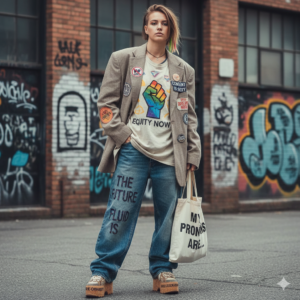
Similarly, the fashion industry has moved from selling aesthetics to selling “sermons.” As explored in our section on Woke Fashion, clothing is no longer about style or utility; it’s a canvas for activism. Whether it’s gender-neutral apparel that deliberately defies traditional biological norms or “sustainable” brands that charge a premium for moral peace of mind, the goal is the same: visible adherence. * The Slogan Tee: The modern equivalent of a religious icon or a crucifix worn around the neck.
-
The “Woke-Wash”: Brands like Nike or Patagonia act as the new “clergy,” issuing moral edicts and selling the vestments required to join the movement.
See more at https://notwokedot.com/woke-and-the-fashion-industry/
The Search for the Sacred
Why has this caught on so fervently? Because loneliness is a crisis. In an era of record-high anxiety and social isolation, the Woke movement offers a “we.” It provides a common enemy to fight and a common language (catechism) to speak.
However, unlike traditional religions that often emphasize forgiveness and humility, this secular version is frequently iconoclastic and punitive. It scours the past for heretics to cancel and demands a moral perfection that is impossible to maintain.
Conclusion: Can We Find Community Without the Cult?
The “Need for Belonging” is real, but when politics becomes a religion, it loses its ability to compromise. It stops being about fixing roads or managing budgets and starts being about a struggle between “good and evil.”
As we look at our plates and our wardrobes, we have to ask: Are we choosing these things because we like them, or because we are afraid of being cast out of the only “congregation” left?

The Glossary of Secular Sins
In traditional faith, a “sin” is a transgression against divine law. In the secular religion of the modern era, a sin is a transgression against the evolving consensus of identity and equity. Here are the primary “offences” one can commit in the eyes of the new elect:
-
Cultural Appropriation: The “theft of the sacred.” This occurs when an individual engages with the food, fashion, or traditions of another culture without “expressed license.” In the woke world, this is seen as a form of spiritual trespassing.
-
Microaggression: The “venal sin.” These are small, often unintentional slights that, according to the new doctrine, reveal a deeper, hidden “impurity” or bias in the speaker’s heart.
-
Deadnaming: A “mortal sin” of speech. To refer to someone by their birth name rather than their chosen name is treated not as a mistake, but as a violent act of erasure and a denial of their fundamental “truth.”
-
Centering: The sin of “selfishness.” This is when a member of a “dominant group” (usually defined by race or gender) shares their own perspective or experience in a way that shifts attention away from a marginalized group.
-
Heteronormativity: The sin of “false tradition.” This is the assumption that the binary of male and female, or the traditional family unit, is the natural standard. To suggest this is the “norm” is to commit a heresy against fluid identity.
-
Unconscious Bias: The “Original Sin.” This is the belief that every person is born with inherent, invisible prejudices that they can never truly be rid of. One can only “do the work” to manage their bias, but they are never fully “cleansed.”
-
Performative Allyship: The sin of “hypocrisy.” This occurs when someone adopts the language or fashion of the movement (like posting a black square or wearing a slogan) but doesn’t commit their resources or power to the cause deeply enough.
Why the Glossary Matters
For the “Not Woke” observer, these terms often feel like a moving target. By defining them as Secular Sins, you expose the underlying mechanism: it’s not about logic or policy, but about moral policing.
When someone is “cancelled,” they aren’t just being fired; they are being excommunicated. They have committed a sin for which the new religion has no ritual for forgiveness—only permanent social exile.
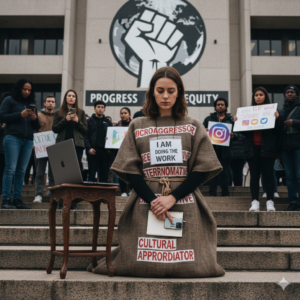
The Sin |
The Required Penance |
The Desired Outcome |
Unconscious Bias |
“Doing the Work”: Mandatory attendance at DEI seminars or reading a prescribed list of “anti-racist” texts. |
Perpetual “education” and acknowledgement of inherent guilt. |
Microaggression |
The Immediate Recantation: An instant, public apology that focuses on “impact over intent.” |
Validation of the “victim’s” feelings regardless of the speaker’s logic. |
Privilege |
Step Back / Step Aside: Voluntarily giving up a platform, a job, or a speaking slot to someone from a “marginalized” group. |
Redistribution of social and professional capital. |
Heteronormativity |
The Pronoun Pledge: Adding pronouns to email signatures and social bios to signal rejection of biological norms. |
Universal adoption of the movement’s linguistic framework. |
Non-Compliance |
The Public Confessional: A long-form “Notes App” apology on social media admitting to “harm” and promising to “be better.” |
Re-entry into the social circle (though often with a permanent “scarlet letter”). |
Cultural Appropriation |
Divestment & Donation: Removing the offending item (fashion/food) and making a public donation to an approved non-profit. |
Spiritual “restitution” for the perceived theft of culture. |
The Sin |
The Required Penance |
The Desired Outcome |
Unconscious Bias |
“Doing the Work”: Mandatory attendance at DEI seminars or reading a prescribed list of “anti-racist” texts. |
Perpetual “education” and acknowledgement of inherent guilt. |
Microaggression |
The Immediate Recantation: An instant, public apology that focuses on “impact over intent.” |
Validation of the “victim’s” feelings regardless of the speaker’s logic. |
Privilege |
Step Back / Step Aside: Voluntarily giving up a platform, a job, or a speaking slot to someone from a “marginalized” group. |
Redistribution of social and professional capital. |
Heteronormativity |
The Pronoun Pledge: Adding pronouns to email signatures and social bios to signal rejection of biological norms. |
Universal adoption of the movement’s linguistic framework. |
Non-Compliance |
The Public Confessional: A long-form “Notes App” apology on social media admitting to “harm” and promising to “be better.” |
Re-entry into the social circle (though often with a permanent “scarlet letter”). |
Cultural Appropriation |
Divestment & Donation: Removing the offending item (fashion/food) and making a public donation to an approved non-profit. |
Spiritual “restitution” for the perceived theft of culture. |