Contemporary Anglophobia refers to opposition, dislike, or hostility directed towards England, its people, culture, or influence in the modern era. Some of the racist sentiment has historical roots and current discussions often centre on a belief in inherited guilt along with wild claims of global rape, looting and pillaging. The rest is snobbery.

Claims of Acceptable Anti-English Bigotry
The claim that anti-English racism or bigotry is uniquely acceptable in some parts of the British Isles primarily stems from anecdotal evidence and specific data points from Scotland and Wales.
Hate Crime Data: Data from Police Scotland in 2018-19 suggested that an estimated 6% of racially aggravated hate crimes recorded had an anti-English prejudice.
Nationalist Movements: Commentators and some public figures argue that while anti-Welsh or anti-Scottish slurs are widely condemned, the use of terms like “Pom” (in Australia and New Zealand) or other pejorative language for the English is often dismissed as harmless banter.
Anecdotal Experiences: English people living in other parts of the UK have reported experiencing discrimination, such as being told to “go back to England” in Scotland or receiving hateful notes in Wales. “Little Englander”, Brexiteer and “Gammon” are all coded expressions of Anglophobia, as is “Flag Shagging”. It’s only called flag shagging when it’s the English flag or the Union Jack. An aversion to the English flag and the Union Flag is associated with Anglophobic racism.
The idea that England and the English are treated with contempt by some “anglophobic elites” or that anti-English racism is an acceptable form of bigotry in parts of the British Isles is a recurring theme in contemporary political commentary and public discourse.
Arguments for the Existence of “Anglophobic Elites”
Proponents of this view, often conservative commentators or English nationalists, argue that certain cultural and political figures, or “elites,” display a casual disregard or even disdain for English identity, culture, and concerns e,g.
An example of this took place in 2014 when the Labour Shadow minister, Emily Thornberry, received criticism after tweeting a photograph as voting was taking place of a house in the constituency adorned with three flags of St. George and the owner’s white van parked outside on the driveway, under the caption “Image from #Rochester”. She later resigned. This would never have happened in Scotland.
During and after the 2016 referendum, commentators in elite media circles often portrayed English nationalism and flag-waving as xenophobic or backward. This reinforced perceptions that elites were hostile to overt English identity.
Displays of the St. George’s flag during the 2018 World Cup were mocked in some media outlets as symbols of “Little Englander” attitudes. Critics argued this showed contempt for ordinary English expressions of pride.
England fans were warned not to fly the St. George’s flag in Russia because it could be seen as “imperialistic” and “antagonistic”. (Evening Standard). Deputy Chief Constable Mark Roberts said: “It can come across as imperialistic and cause antagonism” (Campaign for an English Parliament).
This reinforced the idea that English symbols were treated as problematic compared to other national flags.
When Nike redesigned England’s football kit in 2024 with a stylised St. George’s cross, critics—including politicians and commentators—argued that elites were “messing with” national symbols. The Telegraph noted that even Thornberry joined in criticism, despite her earlier controversy, highlighting how English identity and symbols are often treated with contempt by elites.
They don’t like us. It’s not just the flag of St George they don’t like, but our culture too. They call us nativists and Gammons, Little Englanders, White Supremacists and other words to hide the one simple fact, that they are prejudiced against the English and all that we stand for. This prejudice is called ‘Anglophobia’.
Evidence of an Anglophobic Demographic.
There is little new here. In terms of party politics, it should not be forgotten that we have a Labour government, that’s not doing well in the polls. In an earlier poll, commissioned by the BBC in 2018, it emerged that some classes of people feel themselves less English than others, namely Labour/Lib Dem voters and the Black Asian Minority Ethnic people living here. Around a quarter of all English Labour and LibDem voters didn’t feel very English and this figure went up 49% for BAME voters. A later Yougov poll published in October 2025 showed that most ethnic minority residents didn’t feel English and that nearly a quarter did not even feel British.
In a 2022 study 8.4% of respondents said they disliked the White British more than any other ethnic group. Data analysis of this poll by both Birmingham University, ChatGPT and Gemini confirms what many will have expected, they are the same sort of people identified in the BBC poll. The single largest demographic group driving that 8.4% figure consists of White British adults who hold progressive, left-leaning, or highly liberal views.
The Driver: This is generally not driven by racial animus, but rather by political and cultural polarisation. Highly progressive individuals often select “negative” for the majority demographic as a proxy for rejecting traditionalism, nationalism, or what they perceive as systemic privilege within their own ethnic group.
The University of Birmingham’s subsequent analysis of this data—published in the British Journal of Sociology—revealed a surprising class dynamic. Certain cultural prejudices and strong ideological opinions in the UK are actually more prevalent among the middle and upper-middle classes (ABC1 social grades) and university graduates than the working class.
Across almost all UK social attitudes tracking, including the British Social Attitudes survey, younger adults (ages 18–34) display vastly different polling patterns regarding identity than older generations. They are significantly more likely to express scepticism, neutrality, or overt criticism toward historically dominant demographics (like White British or Christians) while showing heightened protective or positive sentiments toward minority demographics.
While a generational gap exists, it’s not uniform. Younger White individuals in Scotland and Wales are significantly more likely to identify only as Scottish or Welsh compared to their grandparents, who still hold onto a lingering post-war Britishness. In Northern Ireland the old national allegiances are dying away. Only in England are the youth becoming less English, convinced by the media that being English is associated with football hooliganism, racism and Fascism, rather than Shakespeare, Chaucer, the Countryside. That having been said, they’re none too proud of being British either.
Left Wing Anglophobia
“Left-wing Anglophobia” refers to the idea that some people on the political left express discomfort, dislike, or strong criticism toward England, English institutions, or English national identity. While traditional Anglophobia simply means a hatred or fear of England, the left-wing version is usually tied to political debates about history, patriotism, and modern social movements.
George Orwell’s Famous Critique
The discussion often traces back to the famous British author George Orwell. In 1941, he wrote a well-known essay called The Lion and the Unicorn.
Orwell argued that English intellectuals were uniquely ashamed of their own country.
He noted that in left-wing circles, people felt it was “slightly disgraceful in being an Englishman”.
He claimed these thinkers preferred to look to other cultures rather than celebrate their own.
He certainly wasn’t wrong. They’re snobs.
Why the Modern Left is Accused of Anglophobia
Critics from the political right and centre often accuse the left of holding anti-English views for several main reasons:
Empire and Colonial History: Many on the left focus heavily on the ‘harms’ caused by the historical British Empire, as if there hadn’t been literally hundreds of empires in world history, and Britain hadn’t been a colony itself. Critics skate over the fact that it was a British Empire, not an English one
Fear of Exclusive Nationalism: Allegations that symbols like the St. George’s cross have sometimes been used by far-right groups. Because of this, some left-wing politicians feel nervous or uncomfortable using these symbols. In reality groups like the National Front, British National Party and Britain First all used the Union Flag, not the English one.
Immigrants, It should also be noted that during 2024 general election campaigning labour activists told Starmer that having the Union Jack on election pamphlets was “problematic” in some areas. That tells us that it isn’t just the left, but also immigrant communities that don’t like us.
Anger Over Brexit: Decisions like leaving the European Union were largely driven by voters in England. Some global-minded leftists view this political shift as a negative form of English nationalism.
Regional Politics: In places like Scotland and Wales, some local left-wing and nationalist politicians use a “blame England” strategy to gain support, which critics label as a form of prejudice. Nobody can say the the SNP isn’t left-wing or nationalist.
The Green Party supports national self-determination for the Scots, Welsh and people of Northern Ireland, but not however for the English. The Green Party is also the only major political party in UK politics not to have signed the IHRA definition of antisemitism
The Counter-Argument: A “Progressive” English Identity
Many modern thinkers on the left reject the label of Anglophobia. They argue that they do not hate England, but rather want to redefine the English. Writers and politicians often try to build a “progressive “English identity that welcomes people of all racial and ethnic backgrounds.
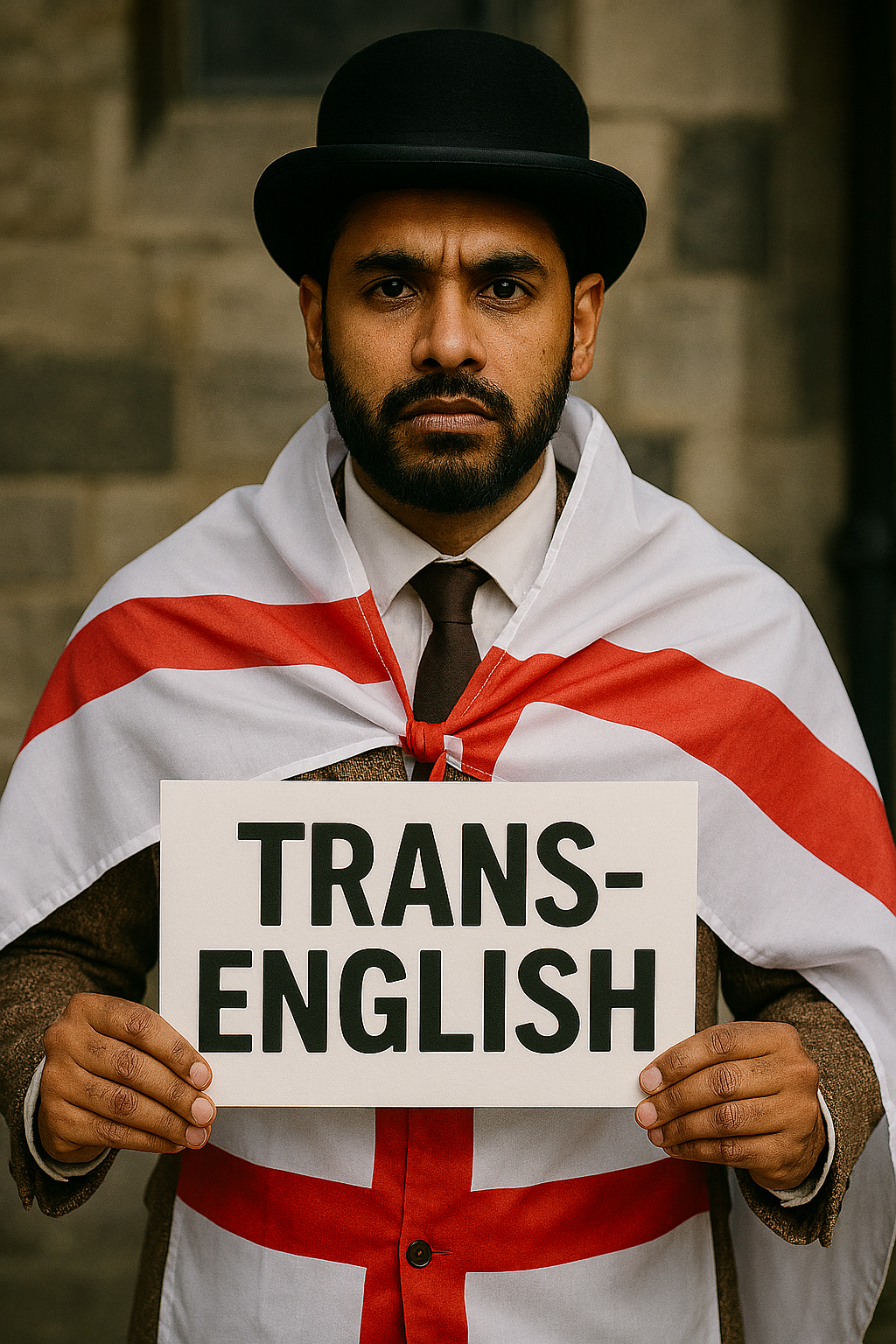
If English identity included everyone that wasn’t English, then the word and identity would have no meaning, and the real English would have no identity. This creation of the “trans-English” is a political tool used to counter arguments that places like London are not longer English. We already have a word which embraces people of all racial and ethnic backgrounds. It is called British.
References
[2] https://www.newstatesman.com
[5] https://www.telegraph.co.uk
[9] https://www.telegraph.co.uk
Other Domestic Anglophobia
Scotland: Anglophobia has been observed in some parts of Scotland, particularly within a minority of independence supporters. It often manifests as an “anti-Nationalist” sentiment being conflated with anti-Englishness, with some individuals reporting being told to “go back to England”. Political proxies like “Westminster parties” are sometimes used, potentially to avoid overt anti-English public relations issues.
Wales and Northern Ireland: Historically, anti-English sentiment has been linked to nationalist movements, such as the arson attacks on English-owned second homes in Wales in the late 20th century by the militant group Meibion Glyndŵr. In Northern Ireland, anti-British sentiment remains a feature of some Irish republican circles.
Official Anglophobia: “Towards a more confident, cohesive, and resilient United Kingdom”
This the name of a government document, leaked, then published in March 2026 and contained a much-watered down replacement definition of Islamophobia. In compensation for which, the Government outlined its plan to water down the English. The document’s stance can be summarised through the following key themes:
Rejection of “English” as an Ethnic Category The document explicitly identifies a danger in allowing “Englishness” to be defined by ethnicity.
The historical record is that a people calling themselves the English emerged during the 7th century. The Office for National Statistics quite clearly defines the English as an ethnic group. Official legal bodies, including the Advisory, Conciliation and Arbitration Service (Acas), explicitly state that English, Scottish, Welsh, and Irish peoples are legally recognized as separate ethnic groups under the “race” protected characteristic. The Harvard Encyclopedia of American Ethnic Groups: Published by Harvard University Press, treats the English as an autonomous ethnic group. So does the Equality and Human Rights Commission (EHRC)
The Government doesn’t though provide an alternative definition of “Englishness” and fails to observe the obvious, namely that the English are an ethnic group and possessed of more Englishness than anyone else. Historian Peter Mandler argued that “Englishness… is not a true estimate of national character, but a construct developed by the dominant classes” (Cambridge University). That certainly rings true. Englishness is a noun describing the distinctive qualities or characteristics that set apart or are felt to set apart the English people, their works, or institutions, and the English are an ethnic group.
Non-English politicians have latched onto the idea and have proudly announced that they are so full of Englishness as now to be English. These politicians, who had lived all their lived without knowing that they’re English, include Sadiq Khan, David Lammy, Rishi Sunak, Priti Patel and the Home Secretary, Shabana Mahmood. They have all become trans-English
Challenging the “Extreme Right”: It states that a failure to promote modern patriotism has allowed the “extreme right” to equate being English with being white or Christian. Since the Office for National Statistics classifies the English as being part of the “White British” ethnic group, it would indeed seem that the English are White.
Ethnic vs. Civic: The text argues that the “vast majority of people reject” the idea of national identity as an ethnic construct tied to race. This idea simply isn’t borne out by polling. Just 29.6% of the population of England listed their national identity as English in the 2021 census. There is no such thing as an English civic identity
Inclusive Definition: It promotes an identity that is “open to all those who call these islands home, regardless of the colour of their skin”, or indeed their nationality. Therefore anyone who lives here is English. The document often uses “English” and “British” interchangeably when discussing culture, but it remains strictly “British” when discussing formal state functions. That’s an easy way of ignoring English culture. When referring to legal status, it uses “British Citizen” or “UK citizen”. It defines the UK’s national identity by its “pluralism,” arguing that people can be from England while still embracing a “shared [British] identity”. It is also most as though it was preparing the population to use the terms British and English interchangeably to the point where the word English had no other meaning than a geographical location. The document views patriotism not as an ancestral tie to a land and its people, but as a “collective act of community-building”. It seems that the government wants to water down English to a point where it only indicates residence. Under this definition, anyone of any ethnicity is considered English, an identity now comparable to Mancunian or Londoner.
It describes “real patriotism” as being “hopeful about the future” rather than “pining for some imagined past”. It seems that now our written history, archaeology and lived experiences are merely imagined. You can imagine how upset they might be at DNA studies confirming this imagined history
Conclusion
The overarching attitude is that a distinct, ethnic English identity is a threat to social cohesion and national security, whereas an inclusive, civic English identity is a “force for good” that strengthens the Union. Other ethnicities and their cultures may be celebrated, but an English ethnicity is a threat.
The text tries to “dilute” English identity and aligns with the document’s explicit goal: it seeks to remove the “limits” of ethnicity from the word English to ensure it can be claimed by any UK resident. By doing so, it attempts to solve the “English problem” by making the identity civic rather than ancestral, thereby preventing it from becoming a source of ethnic or political friction that could destabilize the United Kingdom. It’s called ethnicity displacement.
Behind this thinking is the awareness that should the SNP be successful in an independence referendum, the UK ceases to be a legal entity. That would confine the word “British” to the world of geography, and those immigrant communities who were persuaded that they were ‘British’ will have no identity in a nation state called England.