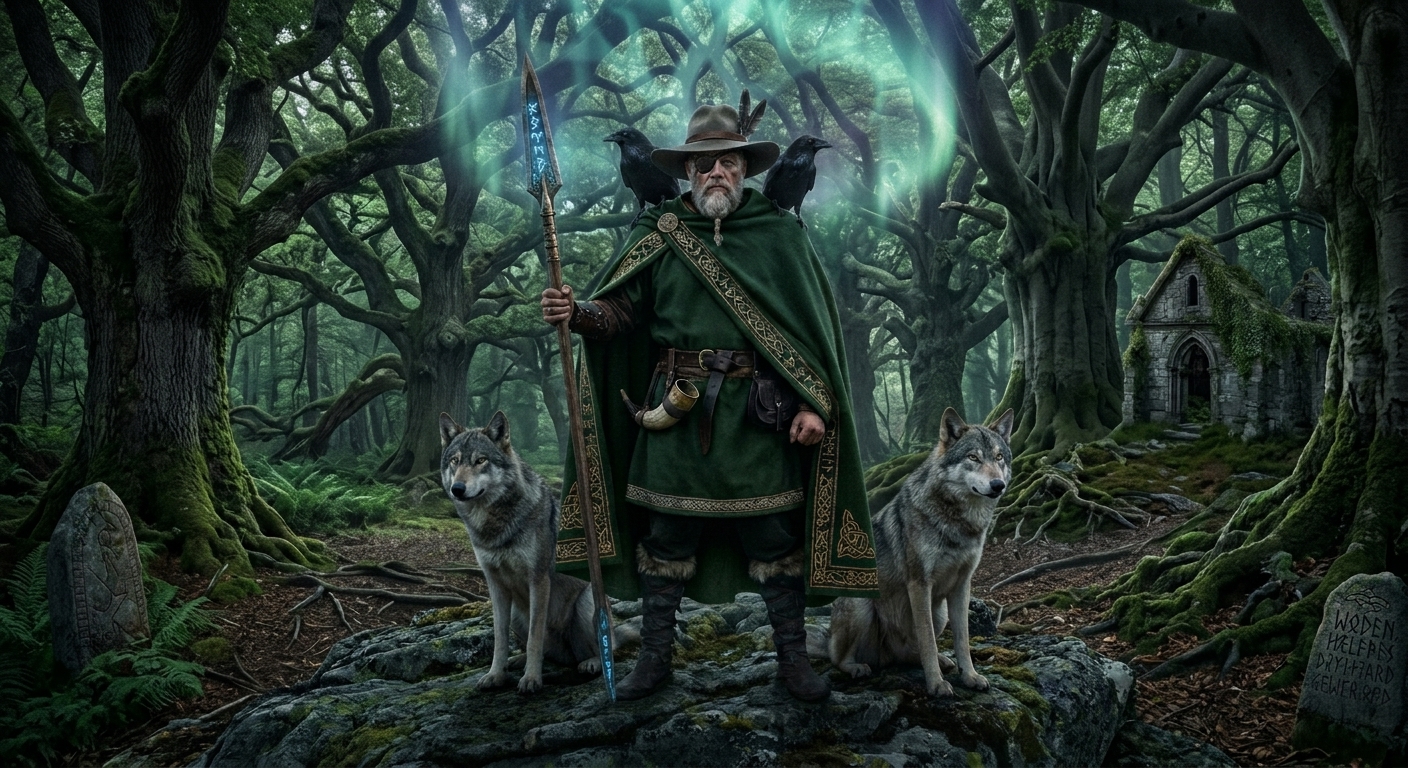
Crimble, as my brother used to call it, is more English than Christian, and Father Christmas is really Woden, or Odin the Norse equivalent. That chocolate Yule Log from Tesco is actually more authentic than singing “Away in a Manger” You still celebrate Yule, not Christmas. You do this with your Xmas decorations, by eating and drinking, and by children hanging up their stockings. You have been doing this for more than one thousand years.
Still worried about being thought a pagan? What about heathen? These aren’t insults, but descriptors. “Pays” is the French word for countryside and a pagan is a country dweller. Heathen comes from heath and has the same meaning in German. In German heath becomes heide, and heathen becomes heiden. Christianity came to the cities first, then to the country dwellers. It’s not about what you believe, but where you come from. Still think it’s Christian? Read on. Find out whether you are culturally Christian or culturally English.
Father Christmas / Santa Claus & Odin (Woden)
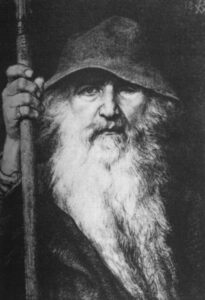
Odin was traditionally depicted as a wise, old, bearded man with a wide-brimmed hat and a cloak, wandering the earth during winter—traits later blended with Saint Nicholas (a 4th-century Greek bishop known for secret gift-giving) to create the modern archetype of Father Christmas. Not for nothing was he also called the Allfather
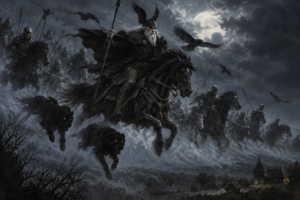
During midwinter, Woden/Odin was believed to lead the Wild Hunt, riding across the night sky on his eight-legged flying horse, Sleipnir. This morphed into Santa flying through the sky with eight reindeer. Children would leave their boots near the hearth filled with hay, carrots, or sugar for Sleipnir. In return, Odin/Woden would fly down the chimney and replace the offerings with gifts or sweets—the direct precursor to hanging Christmas stockings.
The Yule Festival and the Yule Log
The word “Yule” (from the Old Norse *Jól*) predates Christianity by centuries and referred to a 12-day midwinter festival celebrated by Germanic peoples to mark the turning of the sun and the return of longer days. People would select a massive log (often oak) and burn it continuously over the 12 days of Yule to honour the sun, ward off evil spirits, and bring good luck for the coming year. The ashes were often kept to fertilise fields or protect homes from lightning. Today, it survives as a decorative mantlepiece log or as a chocolate cake (*Bûche de Noël*).
In the Saga of King Haakon the Good, Snorri records a detailed, step-by-step account of how pre-Christian Norwegians celebrated Yule before King Haakon I legally merged the festival with the Christian date of Christmas in the 10th century. “It was old custom, that when there was to be sacrifice, all the farmers should come to the place where the temple stood, and bring with them all the provisions they required while the feast lasted.
At this feast, all the men were to have ale; and all kinds of cattle were killed, and horses also. All the blood that came from them was called hlaut… and with it they smeared the sacrificial pedestals, and the walls of the temple inside and out, and sprigs of trees were dipped in it like sprinklers, and with this the people were sprinkled. The meat was boiled, and served as food for the feast.
Fires were lit in the middle of the floor of the temple, and kettles hung over them. The sacrificial bowl was carried around the fire, and he who made the feast and was the chieftain consecrated the bowl and all the sacrificial meat. First, Odin’s toast was drunk—for victory and power to his king; then Njörd’s toast and Freyr’s toast for good harvests and peace. It was the custom of many to drink also the Bragafull (the chieftain’s or ancestor’s toast), and then they drank to their departed kin.”
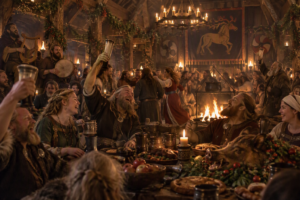
Ritual Toasting (Minni) – Drinking ale and mead was not just merriment; it was a sacred obligation. Toasts were offered in a strict sequence: Odin for victory, wisdom, and military power, Njörd & Freyr for fertility, good weather, bountiful harvests, and peace (til árs ok friðar), then ancestors & Heroes (Bragafull): Horns of ale were passed around the fire to honour deceased family members, often accompanied by solemn oaths or vows for the coming year.
Another early account comes from the English monk Bede in his 725 AD treatise De temporum ratione (“The Reckoning of Time”). He described how Anglo-Saxon pagans marked the start of their Yule season: “They began the year on the 8th day before the Calends of January [December 25], which is now the night on which we celebrate the birth of the Lord. That very night, which is now so sacred to us, was called by them Módraniht—that is, ‘Mother’s Night’—because, I suspect, of the ceremonies which they performed through the night.”
This indicates that before the Christianisation of Britain, Yule began with an all-night vigil honouring ancestral mothers and female fertility deities (Disir or Matrones).
Holly and Ivy Stuff
Bringing green plants indoors during the dead of winter was a universal pagan practice across Europe to symbolize life persisting through the dark, cold months. The Christmas Tree is Christian, but Germanic tribes revered evergreen trees as symbols of enduring life and fertility because they did not die in winter. Oak trees were sacred to Thor, and fir trees were associated with various winter deities. Druids and Celtic peoples considered mistletoe sacred because it stayed green and produced white berries even in winter. It was harvested with golden sickles and used in fertility rites and as a protective amulet against evil spirits. The custom of kissing under the mistletoe stems from its association with love, fertility, and reconciliation. In Celtic folklore, holly and ivy represented the battle between the seasons. Holly (associated with the Holly King, who ruled the dark half of the year) and ivy were brought indoors to protect homes from malevolent spirits.
Christmas Carols
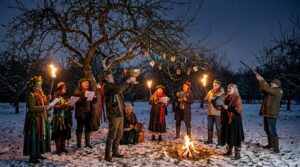
Wassailing is derived from the Anglo-Saxon phrase “Wæs þu hal” (“be thou well”). Wassailing involved groups going door-to-door singing, drinking spiced cider or ale from a communal bowl, and offering good health to neighbours—often accompanied by demands for food and drink. This practice directly morphed into Christmas caroling and “goose-shearing” or mumming traditions.
Foreign Influences
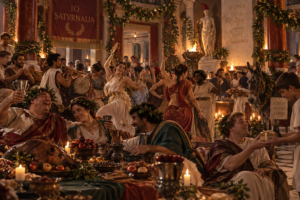
The ancient Roman festival of **Saturnalia**—dedicated to the agricultural god Saturn—was one of the most influential precursors to modern Christmas. Held from **December 17 to December 23**, it coincided with the winter solstice and deeply shaped both the timing and the celebratory spirit of the holiday.
There is a common misconception that the Church arbitrarily picked December 25 to overwrite Jesus’s actual birth date. While early Christian theologians calculated symbolic dates, the choice of late December was heavily influenced by existing Roman celebrations. Sol Invictus: In 274 AD, the Roman Emperor Aurelian established the festival of *Dies Natalis Solis Invicti* (the “Birthdays of the Unconquered Sun”) on December 25. This celebration marked the turning point of the year when days began to lengthen again after the winter solstice.
Christian Appropriation: As the Roman Empire Christianised, church leaders deliberately reframed the winter solstice celebrations. Instead of honouring the sun god or Saturn, they designated December 25 as the birthday of Jesus Christ—the “True Light of the World”—allowing citizens to maintain their festive calendar while shifting its theological focus. Saturnalia was characterised by a suspension of normal rules and societal hierarchies, a vibe that heavily influenced European Christmas celebrations like Twelfth Night and Christmas revelry:
Role Reversals: During Saturnalia, social norms were inverted. Masters served banquets to their enslaved people, and social hierarchies were temporarily dissolved. This spirit of egalitarian merrymaking lives on in the festive indulgence and casual atmosphere of modern holiday office parties and family gatherings. At Christmas in the British Army, the soldiers are waited upon by their superiors for their Christmas Dinner. Continuous Feasting:Public banquets and private dinner parties dominated the week. The focus on overeating, drinking wine, and hosting lavish meals became a permanent fixture of midwinter celebrations across Europe.