Who Do We Hate The Most?

Who Do We Hate The Most?

 This report is based on a survey designed by the authors with support from YouGov. It was conducted by YouGov between 20th and 21st July 2021 using an online interview with members of YouGov’s participant panel, comprising over 185,000 individuals. Panellists were contacted at random by email based on sample criteria, which were designed to gather data on a representative sample of the adult population of Britain. In total, 1667 people completed the survey. Prior to analysis, the sample was weighted by age, political measures, gender, social grade, region and level of education to ensure representativeness, with the census, Labour Force Survey, Office for National Statistics estimates, and other large-scale data sources being used to inform target quotas.

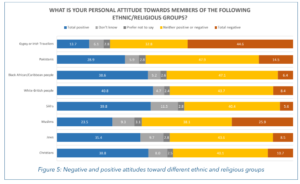
It appears in a university research document on islamophobia and contains some interesting insights, although we’re not exactly told who’s doing the hating.  Firstly though let’s see which ethno-religious groups are the most liked in the UK:

Liked the Most

Indigenous Population

Immigrant Population

White British

40.8% see these positively

Sikhs

39.8% see these positively

Christians

38.8% see these positively

Black People

38.6% see these positively

Gypsies/Travellers

13.7% see these positively

Jews

35.4% see these positively


Pakistanis

28.9% see these positively

Muslims

23.5% see these positively


Disliked the Most

Native Population

Immigrant Population

Gypsies and Irish Travellers 

44.6% of people view these negatively

Muslims

25.9” of people view these negatively

Christians

10.7% of people view these negatively

Pakistanis

14.5% of people view these negatively

White British People

8.4% of people view these negatively

Jews

8.5% of people view these negatively

Black

6.4% of people view these negatively

Sikhs

5.6% of people view these negatively


Gypsies weigh in as the least liked and most disliked, Muslims come second, but have their own word, Islamophobia, to compensate. Pakistanis come third in the unpopularity table.

Most liked and least disliked are the White British, followed by Sikhs, Blacks, Jews and Christians
AI Analysis

Are the anti-Christians also anti-Muslim?

There is a clear statistical overlap, but the data from that specific YouGov survey reveals two distinctly different types of people driving these numbers.

Cross-referencing the full dataset from the University of Birmingham’s report reveals that the 10.9% who expressed anti-Christian sentiment split into two primary cohorts regarding their views on Muslims: 

 The Secular/Militant Atheist Cohort (Anti-Christian AND Anti-Muslim)

A significant portion of the people who viewed Christians negatively also viewed Muslims negatively.  For this group, the hostility is not directed at a specific race or minority, but at organized religion as a whole. They view religious literalism, scripture-based morality, and public expressions of faith—whether Christian, Muslim, or Jewish—as outdated, socially conservative, or harmful to progressive values. 

 The Progressive Political Cohort (Anti-Christian BUT Pro-Muslim)

The remaining portion of that 10.9% showed a sharp divergence: they viewed Christians negatively but held favourable views toward Muslims. 

 This cohort is heavily made up of younger, left-leaning, and highly educated activists. From their ideological viewpoint, Christianity is viewed through the lens of institutional power, historic colonialism, and the British “establishment” (such as the Church of England’s political influence). They evaluate it negatively as a symbol of dominant systemic structure.

 Conversely, they view Muslims through the lens of a marginalized, racialized minority group facing systemic Islamophobia and social disadvantage. Because their primary political motivator is defending marginalized groups, they express solidarity with Muslims while simultaneously expressing hostility toward the historic majority religion (Christianity).  

 If you were to isolate the 10.9% of respondents who disliked Christians:Roughly half of them also disliked Muslims, driven by a general disapproval of all organized religion.The other half viewed Muslims favorably, driven by a political ideology that critiques majority institutions while defending minority communities.

https://www.euro-islam.info/2022/02/15/the-dinner-table-prejudice-islamophobia-in-contemporary-britain/

https://discovery.ucl.ac.uk/id/eprint/10176829/1/British%20Journal%20of%20Sociology%20-%202023%20-%20Jones.pdf

https://www.brookings.edu/articles/prejudice-towards-muslims-is-highest-among-all-religious-and-ethnic-groups/)

 Who hates the White British?

Sociological follow-ups show that minorities who report having personally faced severe or systemic racism in the UK are the most likely to project negative views back onto the majority White British demographic.

The data revealed that holding negative views toward the dominant majority (White British) or the historic majority religion (Christianity) was heavily correlated with political ideology rather than minority status. Respondents who identified as strongly left-wing or voted for the Labour Party or the Green Party were statistically much more likely to report negative feelings toward White British and Christian groups.

Academics tracking this noted it stems from an ideological critique of structural privilege and institutional power. Within these political groups, “White British” and “Christian” are frequently associated with traditional establishment power, colonialism, or social conservatism, sparking negative evaluations from highly liberal progressives.

Anti-English sentiment (often termed Anglophobia) is not a dominant or heavily institutionalised prejudice within the UK, but where it does manifest, it is primarily driven by political nationalism, historical grievances, and regional socio-economic dynamics rather than distinct ethnic or religious divides. Sociological data and public surveys highlight the specific groups and contexts where this sentiment is most visible: 

 Scottish Nationalists: The highest concentrations of anti-English sentiment within the UK are found in Scotland. Studies indicate around one-third of English residents in Scotland perceive some degree of Anglophobia. This is strongest among supporters of Scottish independence, who often associate Englishness with Westminster’s political dominance. However, researchers note much of this manifests as “banter” or sporting rivalry rather than personal hostility.   

Irish Republicans: In both Northern Ireland and the Republic of Ireland, anti-English sentiment is traditionally rooted in Irish nationalism and historical grievances regarding British rule. In Northern Ireland, it is strongly concentrated within Catholic, Nationalist, and Republican communities. 

Welsh Cultural Nationalists: In Wales, a mild form of anti-English sentiment exists among groups focused on preserving the Welsh language and culture. It often targets the influx of English buyers into local housing markets, which locals feel prices out younger Welsh generations.  

Religious and Ethnic Groups

 Academic surveys show that British ethnic minorities (including Black, Asian, and Middle Eastern communities) generally report high levels of British national identity and do not disproportionately express anti-English views. When tension does arise, it is typically directed toward  English nationalism rather than English people as a whole.  

 [1] [https://en.wikipedia.org](https://en.wikipedia.org/wiki/Anti-English_sentiment)

[2] [https://en.wikipedia.org](https://en.wikipedia.org/wiki/Anti-English_sentiment)

[3] [https://journals.sagepub.com](https://journals.sagepub.com/doi/10.5153/sro.922)

[4] [https://en.wikipedia.org](https://en.wikipedia.org/wiki/Anti-English_sentiment)

[5] [https://en.wikipedia.org](https://en.wikipedia.org/wiki/Anti-English_sentiment)

[6] [https://radar.brookes.ac.uk](https://radar.brookes.ac.uk/radar/items/7106e6a7-cefc-4354-a557-77e2bca7c45d/1/)

[7] [https://www.thetimes.com](https://www.thetimes.com/travel/destinations/uk-travel/scotland-travel/glasgow/anti-english-prejudice-rife-in-scotland-survey-finds-skgqpmmlsw5)

[8] [https://www.thetimes.com](https://www.thetimes.com/travel/destinations/uk-travel/scotland-travel/glasgow/anti-english-prejudice-rife-in-scotland-survey-finds-skgqpmmlsw5)

[9] [https://www.tandfonline.com](https://www.tandfonline.com/doi/full/10.1080/1070289X.2022.2064082)

[10] [https://journals.sagepub.com](https://journals.sagepub.com/doi/10.5153/sro.922)

[11] [https://journals.sagepub.com](https://journals.sagepub.com/doi/10.1177/1012690212454359)

[12] [https://en.wikipedia.org](https://en.wikipedia.org/wiki/Anti-British_sentiment)

[13] [https://www.quora.com](https://www.quora.com/Is-there-a-stronger-anti-British-sentiment-in-Northern-Ireland-or-the-Republic-of-Ireland)

[14] [https://link.springer.com](https://link.springer.com/content/pdf/10.1007/978-1-349-26863-4_5.pdf)

[15] [https://www.reddit.com](https://www.reddit.com/r/AskIreland/comments/1873pze/do_you_think_its_time_that_we_let_go_of_our_anti/)

[16] [https://www.reddit.com](https://www.reddit.com/r/Wales/comments/wxd4p8/a_note_on_antienglish_sentiment/)

[17] [https://news.bbc.co.uk](http://news.bbc.co.uk/1/hi/wales/1477120.stm)

[18] [https://blackfeministcollective.com](https://blackfeministcollective.com/2022/05/13/black-british-english-what-is-the-relationship-between-language-race-class-in-london/)

[19] [https://www.reddit.com](https://www.reddit.com/r/explainlikeimfive/comments/jwgwm/eli5_the_hatred_among_the_irish_scottish_and/)

[20] [https://hummedia.manchester.ac.uk](https://hummedia.manchester.ac.uk/institutes/code/briefingsupdated/who-feels-british.pdf)

[21] [https://www.trtworld.com](https://www.trtworld.com/article/12764574)

[22] [https://www.tandfonline.com](https://www.tandfonline.com/doi/full/10.1080/1369183X.2024.2385000)

[23] [https://study.com](https://study.com/academy/lesson/england-ethnic-groups.html)

[24] [https://en.wikipedia.org](https://en.wikipedia.org/wiki/Classification_of_ethnicity_in_the_United_Kingdom)

[25] [https://en.wikipedia.org](https://en.wikipedia.org/wiki/Anti-British_sentiment)

[26] [https://www.wikidoc.org](https://www.wikidoc.org/index.php/Anglophobia)