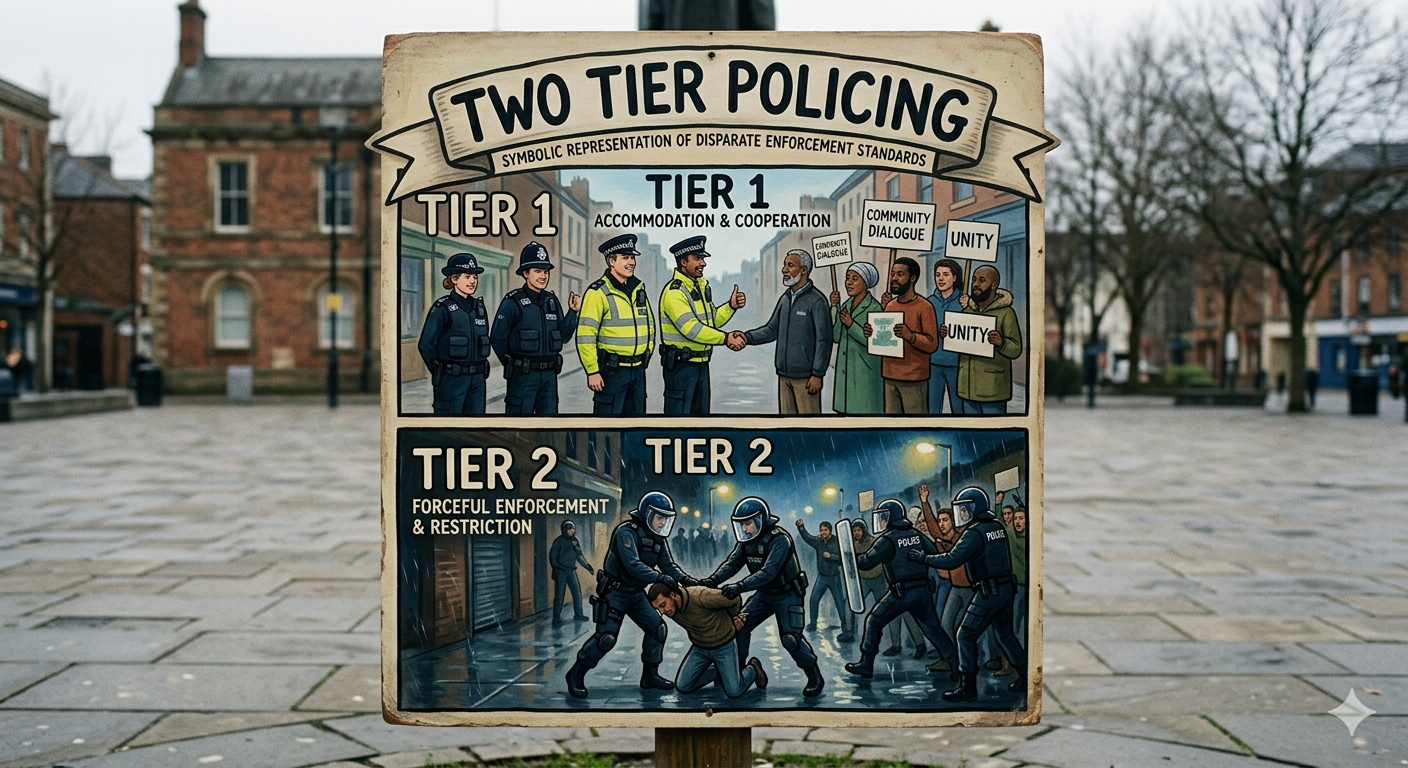
It is alleged that a police failure to properly identify the victim (Henry Nowak) in a knife attack in Southampton was down to the police being conditioned to think of non-White people as always the victim and White ethnic minorities as always the perpetrators, in short an anti-White bias prevalent throughout the police estate nationally. Let’s look at some recent examples of why they might think so.
National Police Chief’s Council of England and Wales abandons Racial Equality
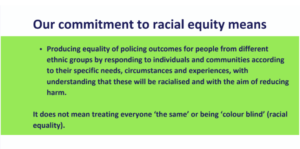
“The police service of England and Wales is committed to anti-racism and racial equity”
“Our commitment to racial equity means producing equality of policing outcomes for people from different ethnic groups by responding to individuals and communities according to their specific needs, circumstances and experiences, with understanding that these will be racialised and with the aim of reducing harm. It does not mean treating everyone ‘the same’ or being ‘colour blind’ (racial equality).”
Equity simply means ‘equality of outcome’ and is not the same as racial equality, or treating people the same regardless of race or ethnicity.
https://www.npcc.police.uk/our-work/police-race-action-plan/police-anti-racism-commitment/
Dorset Police seeking to reduce “racial disparities in criminal justice outcomes”?
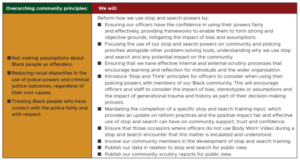
What next? Will it invent English grooming gangs targeting Pakistani teenage girls? One of the criminal justice outcomes in society is that 18% of prison beds in England and Wales are occupied by Muslims and zero per cent are occupied by Hindus:
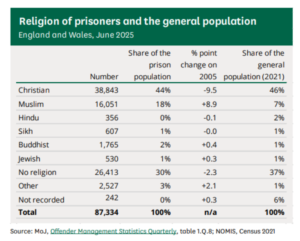
To achieve an equality of outcome society would have to imprison more Hindus as a matter of policy and jail fewer Muslims because of their religion. Atheists are under-represented in the justice system, so perhaps they should see more jail time too. To be fair though, Dorset Police’s policy is to improve outcomes for Black people, whom it subjects to stop and search procedures at a rate it struggles to explain
The Ministry of Justice (MoJ) Sentencing Guidelines Scandal
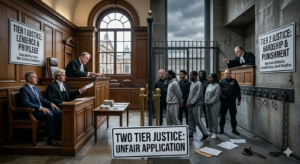
The Ministry of Justice (MoJ) sentencing guidelines row in the spring of 2025 was a high-level constitutional clash over whether courts should use different procedures for offenders based on their ethnicity, race, or religion.
The stand-off pitted the independent Sentencing Council for England and Wales against the Ministry of Justice (MoJ) and Parliament. It led to the introduction of emergency blocking legislation amid widespread political arguments over “two-tier justice”.
In late 2023, the Sentencing Council drafted an overhaul of guidelines for judges and magistrates regarding community orders and custodial sentences.
The specific clause that triggered the row directed that judges and magistrates should automatically order a Pre-Sentence Report (PSR)—an in-depth background check compiled by probation staff—before sentencing any offender belonging to an ethnic, cultural, or faith minority. People with PSRs usually get lower sentences than those without. That would have meant minorities receiving less punishment than the native White British population for the same offence.
The guidance provoked immediate political condemnation across both main political parties, peaking just before the rules were set to take effect on 1 April 2025.
Then-Justice Secretary Shabana Mahmood formally intervened, demanding the Sentencing Council remove or rewrite the sections singling out specific cohorts. When the independent Council initially refused to back down, the government escalated the conflict to a constitutional level and threatened to introduce a new law making the practice illegal. The Sentencing Council then backed down.
Maccabi Football Club – Police Chief forced to resign
In October 2025, ahead of the UEFA Europa League fixture between Aston Villa and Maccabi Tel Aviv at Villa Park on 6 November 2025, the Birmingham Safety Advisory Group (SAG)—acting heavily on West Midlands Police recommendations—reduced the ticket allocation for away fans to zero, enforcing a total ban on Israeli supporters. To justify the ban, WMP falsely claimed that Maccabi fans presented a uniquely dangerous policing challenge.
This story soon fell apart under independent scrutiny by His Majesty’s Inspectorate of Constabulary (HMICFRS) and the House of Commons Home Affairs Select Committee:
The Police explicitly presented historical “evidence” to authorities and Parliament regarding previous violent clashes between Maccabi Tel Aviv and West Ham United in 2023, a football match which never took place. Chief Constable Guildford blamed Microsoft’s Copilot AI, although as far as we know he was never able to prove it.
The Police also claimed that Dutch police required 5,000 officers to handle Maccabi fans during a 2024 fixture in Amsterdam, and that Israeli fans had gone around throwing Muslims into a river. The Amsterdam Police publicly intervened, stating that WMP’s intelligence figures were heavily fabricated and “unrecognisable”.
Chief Inspector Sir Andy Cooke concluded that WMP suffered from extreme confirmation bias, actively “scraping” for and inventing reasons to block the fans rather than objectively assessing the threat.
The row tied directly back into the “two-tier policing” debate. Critics and MPs argued that WMP’s internal intelligence actually showed that local (Muslim) counter-protesters in Birmingham were planning to violently target the Israeli visitors. Instead of policing the streets to protect the visiting (Jewish) fans, WMP chose to ban the potential victims to save money and avoid logistical strain. Critics labelled this a “monstrous decision” that effectively punished the target demographic rather than controlling local antisemites.
Chief Constable Craig Guildford apologised multiple times to Parliament for misleading MPs—first for falsely claiming the local Jewish community supported the ban, and second for denying that AI was used to fabricate the evidence. Following a declaration from the Home Secretary that she had entirely lost confidence in his leadership, Guildford resigned and retired with immediate effect. She said she would have sacked him if she could.