Statistics create numbers from generalities and stereotypes. We can use statistics to generalise about groups in large numbers with some accuracy. But, what is true for 50% of a group isn’t true for the other 50%. Statistics cannot be used to categorise an individual, or speak in generalities about him. There are far too many unknown variables to do that.
It’s also useful to compare groups in order to identify what is exceptional and what the norm looks like
Muslim Prison population
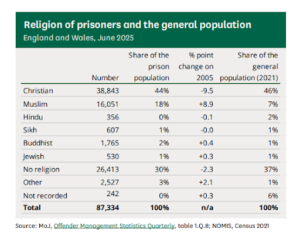
18% of the prison population of England and Wales are Muslims. One estimate says that 30% of these are converts. There are no other estimates about conversions
Do more than 50% of Muslim Men have a Criminal Record?
As of early 2026, approximately 25% (1 in 4) of the UK’s working-age population (aged 16–64) has a criminal record. This represents between 9.4 and 12.6 million individuals. Composition of Records: A “criminal record” is a broad term; estimates indicate that while 27% of working-age adults have a criminal conviction, the wider figure of 1 in 4 for “nominal records” also includes cautions, reprimands, and cases where no further action was taken.
Annual Growth: The number of individuals with records increases by roughly 200,000 per year, a growth rate of approximately 1.67% annually.
Given that 18% of the prison population of England and Wales are followers of Islam, what is the best estimate for the percentage of Muslims having a criminal record?
Using current 2026 data and the most recent Ministry of Justice and Office for National Statistics figures, the following is the best possible estimate:
Based on current 2026 data and necessary adjustments, about 47% to 48% of the Muslim working-age population is estimated to have a criminal record. This figure is heavily influenced by gender. Since 33% of all UK men have a criminal record and the Muslim population is significantly more male-heavy in its younger, “crime-prone” cohorts, the rate for Muslim men specifically likely exceeds 50%, while the rate for Muslim women remains significantly lower than the average.
References – https://notwokedot.com/do-more-than-half-of-muslim-men-have-a-criminal-record/
MI5 Caseload
“The headline split of our counter terrorist work remains roughly 75% Islamist extremist, 25% extreme right-wing terrorism.”
https://www.mi5.gov.uk/director-general-ken-mccallum-gives-latest-threat-update
Terrorist Incidents in Great Britain (UK Mainland) Since 2000
99 Dead and 973 injured by Islamic terrorists this century. The attacks came from the 7% of the population which is filling 18% of our prison cells. If the other 93% of us were like that 7%, then the prison population would be at 300,000, there would be a thousand dead from terrorist attacks and 12,000 injured,
Thirty-one perpetrators, of which 28 were immigrants or the sons of immigrants, 28 were Muslims. Around half were of Commonwealth heritage, ie from a Commonwealth country, or their parents were. As far as is known around seven of them had been asylum seekers.
https://notwokedot.com/terrorist-incidents-in-great-britain-uk-mainland-since-2000/
Islamist Extremist Views
June 2026 Understanding Islamo-populism
Policy Exchange commissioned JL Partners (a member of the British Polling Council [BPC]) to conduct a survey of British Muslims living in parts of England which are of considerable electoral significance in respect of the forthcoming local elections.
“A quarter of the British Muslim respondents across the polled areas have a favourable view of Hamas (25%), with 28% holding an unfavourable one. They were more likely to have a favourable view of the Islamic Revolutionary Guard Corps in Iran than an unfavourable one (23% / 20%).”
Both these organisations are proscribed in Britain and in the EU.
“More than half – 52% – of the British Muslim respondents across the polled areas support making it a criminal offence to show or create images in public which depict The Muslim Prophet Muhammad.”
Muslim Identity
815 adult British Muslims were surveyed by Whitestone Insight, a member of the British Polling Council, between 20 November 2024 – 1 December 2024.
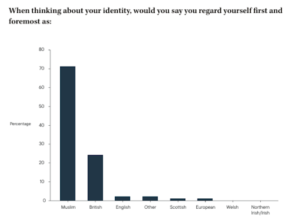
However when we see how age affected their sense of identity, youth seems to have rejected British identity. 85% of under 25s don’t see themselves as British. With 4 million Muslims now living in the UK, mainly concentrated in England, critical mass has been achieved and the need to integrate has fallen away.
MUSLIM ANTI-SEMITISM IN CONTEMPORARY GREAT BRITAIN BY DR RAKIB EHSAN March 2020
“When compared with their perception of other faith groups, British Muslims have the least favourable attitude towards Jewish people. The only people viewed less favourably by British Muslims than Jewish people are those belonging to no religious group (atheists/non-believers).”
37% of the population of England and Wales are atheists according to the 2021 Census.
HRA, EHRC Incompatibility
While mainstream Islamic theology shares many ethical principles with international human rights frameworks — such as justice, dignity, and charity — there are areas where traditional interpretations of Islamic law (sharia) may conflict with modern human rights norms, particularly when applied in legal or political contexts. Below is an analytical summary.
Freedom of Religion & Apostasy – Islamic position (traditional): Apostasy (leaving Islam) is often viewed as a grave sin. In classical jurisprudence, some schools prescribe punishment, including death, though others advocate for no temporal punishment.
Conflict with: Article 9 ECHR & UDHR: Freedom of thought, conscience, and religion, including the right to change religion. HRA 1998 (Schedule 1): Incorporates this right.
Note: Most contemporary Islamic scholars and many Muslim-majority states do not enforce penalties for apostasy, but it remains a live theological and legal debate.
Equality Between Sexes – Islamic position (classical): Men and women have complementary roles, but traditional jurisprudence includes: Men as heads of households, Differences in inheritance rights (e.g., daughters receive half a son’s share), Male guardianship requirements in marriage in some interpretations
Conflict with: Equality Act 2010: Prohibits gender discrimination, ECHR Article 14 & Protocol 12: Prohibits discrimination, UDHR Article 2: Equal rights without distinction of sex. Modern interpretation: Many contemporary Muslim thinkers argue for gender equality within an Islamic framework, but traditional rulings remain widely taught.
Sexual Orientation and LGBT+ Rights – Islamic position (mainstream): Homosexual acts are traditionally considered sinful, and some Islamic legal systems criminalize them.
Conflict with: Equality Act 2010: Prohibits discrimination based on sexual orientation, ECHR Article 8 & 14: Right to private life, non-discrimination, UDHR Article 2: Equal dignity and rights. In practice: Muslim individuals and communities vary widely. Some adopt inclusive interpretations; others maintain conservative stances.
Blasphemy and Freedom of Expression – Islamic position (traditional): Blasphemy (insulting the Prophet or Islam) is often considered a major offence, with some schools prescribing severe penalties.
Conflict with: ECHR Article 10 & HRA: Freedom of expression, UDHR Article 19: Right to freedom of opinion and expression. Contemporary note: Most Muslims oppose violent enforcement of blasphemy laws but believe in respecting religious symbols.
Non-Muslims in Islamic Law – Islamic position (classical): In traditional Islamic governance, non-Muslims (dhimmis) had protected but subordinate legal status (e.g., subject to jizya tax, limitations on religious expression).
Conflict with: ECHR, HRA, EA 2010, UDHR: Require full equality regardless of religion. Modern application: These classical rules are generally not enforced today outside of some theocratic states, and many Islamic scholars call for equal citizenship for all.
Economic inactivity
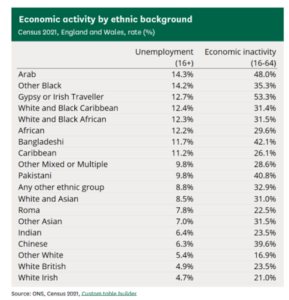
I stumbled upon this small chart from the Annual Population Survey recently. I don’t have an account there, so can’t access more up to date information. It seems that there is even a religious divide in economic inactivity. Its estimate is 38% for Muslims and 19% and 21% for atheists and Christians respectively
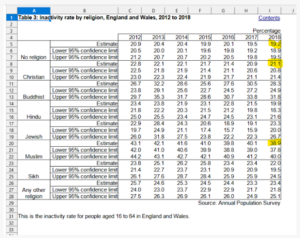
The figures are broadly comparable to what we know about ethnic group employment: